Solar Pool Skimmer: Does It Keep Leaves Afloat?
The Anpool P1 is a hands-off solar pool skimmer that quietly collected floating leaves and grass in my pool, then backed itself out after bumping the ladder.
Affiliate disclosure: As an Amazon Associate I earn from qualifying purchases. This article may contain affiliate links, which means I may earn a commission at no extra cost to you.
The Anpool P1 is a solar pool skimmer for the everyday problem of leaves, grass, and other debris floating on the water. I put it in my pool with leaves and grass on the surface, let it roam, and returned about an hour later to a clear visible surface. It moved quietly, turned away from a wall, and worked itself free after bumping my ladder. For the narrow but useful job of keeping floating debris from becoming bottom debris, it handled the assignment.
The important distinction is that this is a surface tool, not a pool vacuum. It collects debris before that debris sinks. That makes a solar pool skimmer most useful as an early step in a regular pool-care routine: get the leaves while they are still floating, then leave floor cleaning to the equipment meant for the floor.
A solid hands-off helper for floating leaves and grass. The Anpool P1 moved quietly, avoided a wall, recovered from my ladder, and cleared the visible surface debris in about an hour—but it cannot collect debris once it sinks.
As an Amazon Associate I earn from qualifying purchases.
Who should buy a solar pool skimmer?
I would consider the Anpool P1 if your pool regularly catches floating leaves, grass clippings, or similar larger surface debris and you do not want to stand there with a hand skimmer every day. The operating idea is simple. Turn it on, place it in the water, and let it move around on its own. There is no remote and no phone app to manage.
That hands-off approach is the appeal. A conventional hand net can certainly collect a few leaves, but it also requires you to notice the debris, walk out to the pool, and do the skimming. The P1 is intended to spend that time moving across the surface instead. It does not target individual leaves or steer toward a visible pile. It simply travels around and gathers what it encounters.
It is particularly relevant if organic debris tends to linger in your water. In my pool, the leaves and grass were still floating when the skimmer reached them, and those were the pieces it collected. A couple of pieces sank before it got there. Once that happens, surface skimming is no longer the right task. Catching debris early is the practical benefit here, because it keeps routine floating debris from turning into a separate bottom-cleaning job.
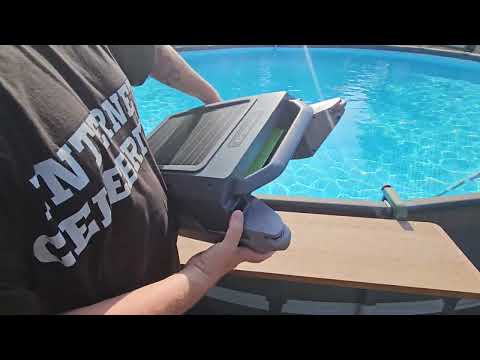
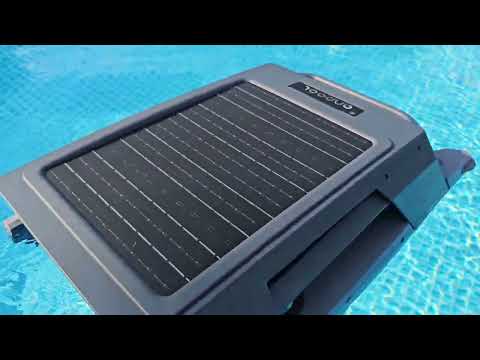
The P1 also makes sense for someone who likes the idea of solar-powered pool equipment and does not want a cord laid across the deck while the unit is working. It has a large solar panel on top, while a rear charging connection gives you a corded charging option before use. I would fully charge it before the first run, then use the solar panel as the skimmer operates on the pool.
| Type | Autonomous floating surface skimmer |
|---|---|
| Power | Top solar panel plus rear corded charging |
| Controls | Rear power switch; no app or remote |
| Collection | Removable, latch-secured debris basket |
| Best for | Floating leaves, grass, and similar surface debris |
My hands-on experience with the Anpool P1
Getting started was straightforward. The rear switch powers the unit on, and I could see the internal fans and blades start up. At the front, a bar is designed to guide floating debris into the basket. Once it was on the water, the P1 began moving autonomously across the surface.
That movement is worth setting expectations around. This is not a precision robot that recognizes a particular leaf, heads directly toward it, and picks it up on command. It makes its way around the pool and collects debris when it reaches it. I think of it as an autonomous surface net making laps rather than a small vacuum hunting down individual pieces of debris.
I watched it approach a pool wall, turn itself around, and avoid a direct collision. It moved quickly over the water and stayed quiet while operating. Quiet operation is a real quality-of-life detail for a pool device that may be running while you are outside. The P1 did its work without adding a noticeable buzzing presence to the pool area.
The ladder encounter was the more useful real-world observation. The skimmer bumped into my ladder, backed itself up, and got free. That is the type of interruption that can turn autonomous equipment into something that needs constant attention, so I was glad to see it recover and continue. The rollers are intended to help it move around after contact with an obstacle, and I saw the unit successfully work itself out at the ladder.
That does not mean every pool obstruction will behave exactly the same way. Ladders, steps, wall angles, and pool shapes vary. In my pool, though, the P1 showed the basic behavior I want from a floating skimmer: keep moving when it meets the kinds of features that are part of a normal pool layout.
What it cleaned—and what it cannot clean
After roughly an hour, the floating debris I could see on the water was gone. It picked up the leaves and grass that remained at the surface, which is the central job I wanted it to do. The front guide bar and basket arrangement are aimed at that kind of collection, and the result in my pool matched the purpose of the design.
There is no magic here, though. A couple of pieces sank before the skimmer reached them. The P1 cannot go down and retrieve debris from the pool floor. If leaves are already sitting on the bottom, you need a pool vacuum, a robotic cleaner designed for floors, or manual vacuuming. Buying this as a replacement for those tools would lead to the wrong expectation.
I see that limitation less as a reason to dismiss the P1 and more as a reason to use it at the right point in the cleanup process. Surface debris is easiest to handle while it is still on the surface. If your pool gets frequent leaves or grass clippings, a surface skimmer can reduce the amount of material that survives long enough to sink. It can complement filtration and vacuuming, but it does not replace either one.
My approximately one-hour result should also be read as a result from my specific pool conditions and the visible debris present that day, not as a universal cleanup time. I did not measure performance with heavy debris loads, fine debris, pollen, different water conditions, or repeated cleaning cycles. What I can say is that it cleared the visible floating leaves and grass I had put it in the pool to address.
Obstacle handling is the standout practical feature
A robotic pool tool is only genuinely convenient if it can continue working without becoming a babysitting project. In my use, the P1 handled the pool wall well and recovered after contacting the ladder. It approached the wall, turned itself around, and avoided a direct hit. At the ladder, it bumped, reversed, and freed itself.
Those two observations matter more to me than a long feature list because they are the situations I actually saw in the pool. A skimmer that gets stuck at the first wall or ladder is not delivering much hands-off value. The P1 kept moving after both situations I encountered.
I would still be realistic with an unusual layout. I did not test it around every possible ladder design, on steps, or in every pool shape, so I cannot say how it will behave around every obstruction. Anpool also markets the P1 with broader navigation features, including smart path planning, automatic parking, and stairway prevention. I used the solar operation and observed its wall avoidance and ladder recovery, but I did not base my recommendation on those additional claims.
+ Pros
- Moved autonomously and turned away from a pool wall in my use
- Backed itself free after bumping into my pool ladder
- Operated quietly
- Cleared the visible floating leaves and grass in about an hour
- Basket was easy to remove, empty, reinstall, and latch
- No app or remote control needed
− Cons
- Only collects debris while it remains floating; it cannot retrieve debris after it sinks
Emptying the basket is refreshingly simple
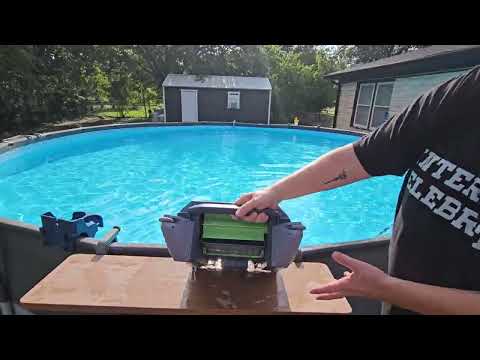
Collection is only half of the ownership experience; eventually, the debris has to come out. When the skimmer had finished its run, I stopped it and removed it from the pool. After letting water drain off, I accessed the basket from underneath using its handle. Pulling that handle releases the basket so it can slide out for emptying.
The basket is the part of the product that turns its roaming into a useful result. Rather than relying on a complicated cleanup process, I could remove the basket, empty what it had collected, and put it back. To reinstall it, I slid the basket into place and latched the handle around the two retaining bars. That secures it for the next run.
This is exactly the kind of maintenance routine I want on a simple pool helper. The device still needs attention when the basket has debris in it, but that attention is direct and uncomplicated. There are no app settings to work through and no complicated tool-based process in the basket removal I used.
Solar charging and control keep the routine simple
The large top-mounted solar panel is central to the P1’s design. It lets the unit work on the water without needing a power cord stretched across the deck. There is also a rear connection for corded charging, and I would start with a full charge before first use.
Because it is solar powered, the intent is to let it continue running while it is out on the pool. I did not measure runtime from a full charge or compare performance under different sunlight conditions, so I cannot give a battery-life estimate. Still, the solar panel and rear charging option make sense for a device whose job is to stay on the surface and roam.
The P1 does not use a remote control or mobile app. For this product, I see that as a practical choice instead of a missing extra. Its job is to float, travel, and collect what it encounters. I turned it on at the rear switch and let it do that. If you want app-based route control or manual steering, this is not the product to choose. If you want to turn it on and get on with something else, the simple control setup is part of its value.
Where the Anpool P1 fits in a pool-care routine
I would treat the P1 as a first line of defense against surface debris. Put it to work when leaves and grass are still floating, empty the basket as needed, and continue using your normal filtration and vacuuming routine for the jobs those systems handle. That division of labor is the clearest way to judge whether it is worth adding.
It is not a one-device answer to every pool-cleaning problem. It will not retrieve sunken debris, and I did not test long-term durability, fine-particle pickup, or performance across many different pool layouts. But the core use case is well defined: reduce the amount of floating debris that remains on the water while you are doing something else.
For pool owners who regularly see leaves or grass on the surface, that can be a meaningful convenience. The P1’s autonomous movement, quiet operation, wall avoidance, ladder recovery, solar-powered design, and simple basket all support that focused role. The key is to buy it for surface maintenance rather than expecting it to replace a vacuum or floor cleaner.
Specs
| Spec | Detail |
|---|---|
| Product | Anpool P1 Robotic Solar Pool Skimmer |
| Power sources | Solar panel and rear corded charging connection |
| Operation | Autonomous surface movement |
| Controls | Rear on/off switch |
| Debris collection | Front guide bar and removable debris basket |
| Obstacle behavior | Wall avoidance and roller-assisted recovery were demonstrated |
| Remote/app | Neither is used for operation |
Scorecard
Cleared the visible floating debris in my pool after about an hour.
Moved around on its own and turned away from a wall.
Backed itself free after bumping my ladder.
The basket was quick to remove, empty, reinstall, and latch.
Useful for floating debris only; it cannot collect debris from the bottom.
Frequently asked questions
Does the Anpool P1 clean the bottom of a pool?
No. The Anpool P1 is a surface skimmer. I used it to collect floating leaves, grass, and similar debris before it sank. It is not a substitute for a pool vacuum or a floor-cleaning robot.
Does this solar pool skimmer need an app?
No. I turned it on using the rear power switch and let it move autonomously. There was no smartphone app or remote control involved in the operation I used.
Can the Anpool P1 avoid obstacles?
In my pool, it approached a wall and turned away before a direct collision. It also bumped my ladder, backed up, and freed itself. That is encouraging for the normal obstacles I encountered, although every pool layout is different.
How do you empty the debris basket?
Remove the skimmer from the water and let it drain. The underside handle releases the basket. Empty it, slide it back in, and latch the handle around the retaining bars to secure it.
Can the Anpool P1 be charged without sunlight?
Yes. Along with the top solar panel, the P1 has a rear connection for corded charging. I would fully charge it before the first use.
Will it collect debris that has already sunk?
No. I saw a couple of pieces sink before the P1 reached them. This is a tool for collecting debris while it remains floating, so sunken material still requires a floor-cleaning solution.
Final recommendation
I like the Anpool P1 for the specific job it is designed to do: reduce floating debris with very little effort from you. It moved quietly, handled the wall, recovered from my ladder, and cleared the visible leaves and grass from the surface in about an hour.
Buy it as a surface-maintenance helper, not as your only pool cleaner. Pair it with your usual vacuuming and filtration routine, use it before debris sinks, and empty the basket when needed. For that narrow role, it offers a simple hands-off way to keep floating leaves and grass from becoming tomorrow’s pool-cleaning chore.
As an Amazon Associate I earn from qualifying purchases.