Cordless Pool Wall Cleaner for Algae: Does It Work?
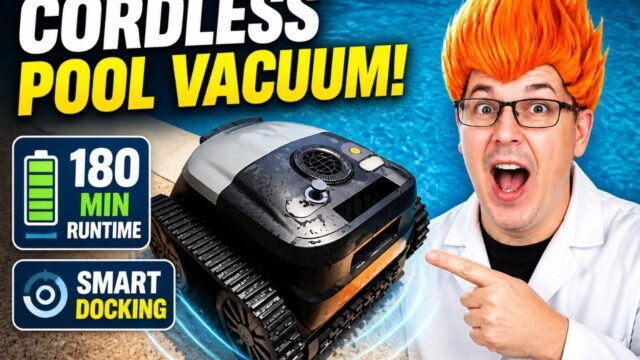
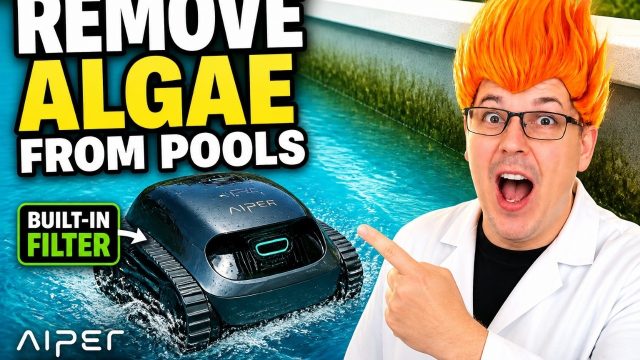
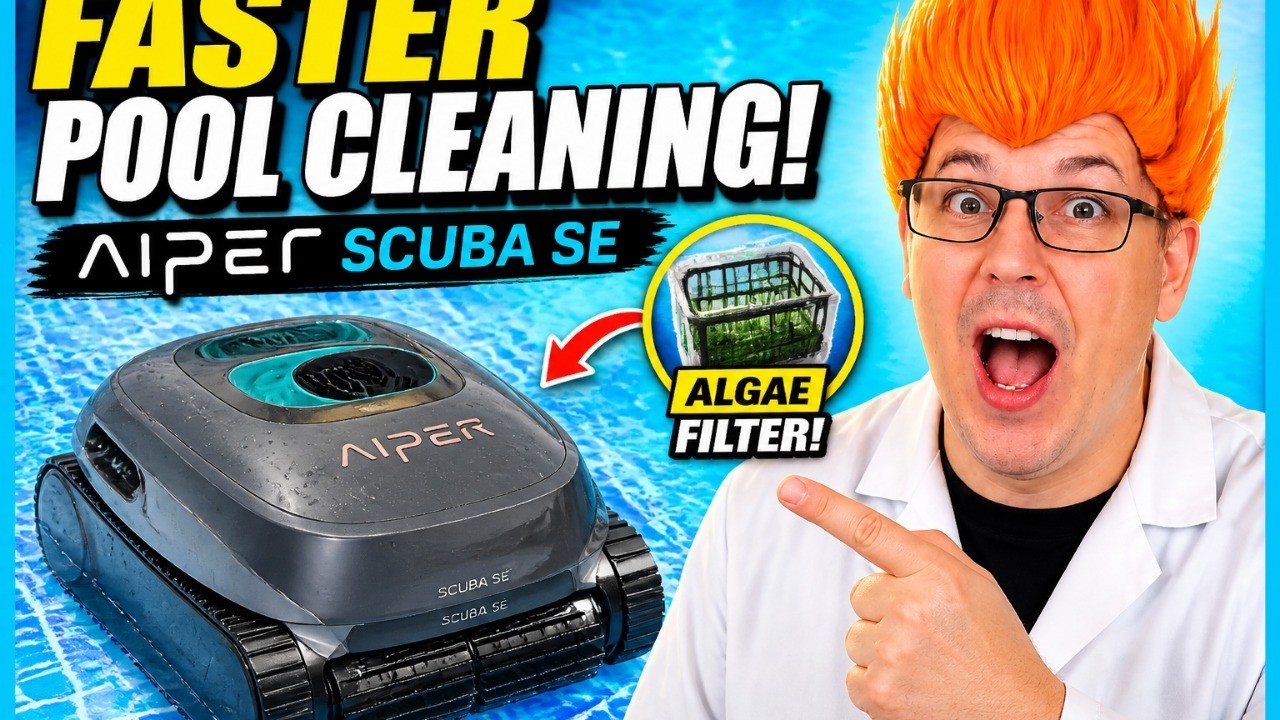
The Aiper Scuba S1 climbed my pool wall, agitated the waterline, and shifted across the surface without a hose to manage.
Affiliate disclosure: As an Amazon Associate I earn from qualifying purchases. This article may contain affiliate links, which means I may earn a commission at no extra cost to you.
If pool walls and the waterline are the jobs you keep postponing, the Aiper Scuba S1 is aimed directly at that problem. I used this cordless pool wall cleaner in wall mode in my in-ground pool and watched it do the part that matters: sink to the bottom, find the wall, climb it, work the waterline with its rollers, drop back down, shift over, and climb again. There was no hose trailing behind it or floating across the pool while it worked.
That cordless setup is the immediate appeal, but it is not the whole story. A robot that only runs the floor does not solve a wall-maintenance problem. What I wanted to see was whether the Scuba S1 could stay on the wall, put its cleaning hardware where grime tends to gather, and move beyond a single narrow lane. In my pool, its tracked tires climbed reliably and its front rollers visibly agitated the waterline area as the robot reached the top of each run.
This is a wall-maintenance tool, not a promise that every algae situation disappears without any other attention. I did not use it on thick, firmly attached algae, and my pool’s ledge limited how high it could travel. Still, for keeping ordinary wall film and waterline buildup from becoming a bigger job, the observed cleaning pattern makes practical sense.
The Aiper Scuba S1 is a strong fit for in-ground pool owners who want a cordless robot to scrub walls and agitate waterline buildup. I watched it climb, shift across the wall, and repeat its path without hoses; just do not expect every pool ledge or high-waterline setup to give it the same reach.
As an Amazon Associate I earn from qualifying purchases.
Why a cordless pool wall cleaner matters for algae-prone walls
Pool walls are easy to overlook because they are out of the usual line of sight. The floor collects visible leaves and debris, while the wall can gradually develop the film and buildup that make a pool look neglected. The waterline is especially likely to need attention. It is a transition area, and it is not cleaned simply because people swim near it or because the circulation system is running.
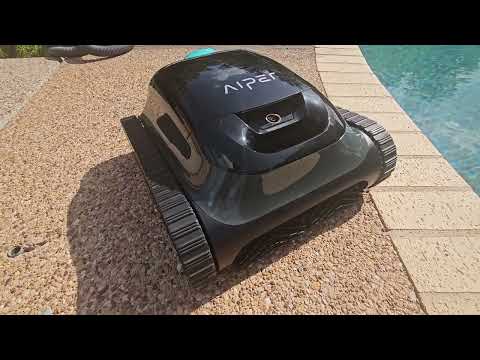
That is why I do not judge a cordless pool wall cleaner solely by whether it moves around the pool. For this job, it needs to reach the vertical surface and make useful contact once it gets there. The Scuba S1 uses large caterpillar-style tracked tires to travel, along with soft rubber/PVC-like rollers at the front. The tracks are the climbing hardware I watched carrying it up the wall. The rollers are what I saw agitating the waterline area.
The alternative is usually manual brushing or working around a hose-based cleaner. Brushing can still have a place for a neglected pool or a stubborn patch, but it is repetitive work. Hose-based cleaners can also work, yet the hose adds something else to manage: it floats, trails behind the cleaner, and can turn a simple maintenance session into equipment handling. With this robot, I selected the cleaning target on the unit and placed it in the water.
That matters for routine use. A product does not have to replace every possible pool-cleaning task to be worthwhile. If it makes regular wall attention less of a production, it can help keep the task from being deferred until the pool walls need much more work. The Scuba S1’s strongest case is that recurring maintenance role, particularly for an in-ground pool owner who is tired of handling hoses and manually brushing the same areas.
| Type | Cordless robotic pool cleaner |
|---|---|
| Best use | In-ground pool wall and waterline maintenance |
| Wall cleaning | Dedicated onboard wall mode |
| Mobility | Tracked, caterpillar-style tires |
| Debris collection | Removable basket |
How the Aiper Scuba S1 tackled my pool wall
I selected wall mode using the onboard control. The available modes are smart, floor, wall, and eco, but wall mode was the appropriate choice for this run because my focus was the wall and waterline rather than a mixed floor-and-wall session. After I put the robot into the pool, it sank to the bottom and then traveled toward the wall with the front rollers leading.
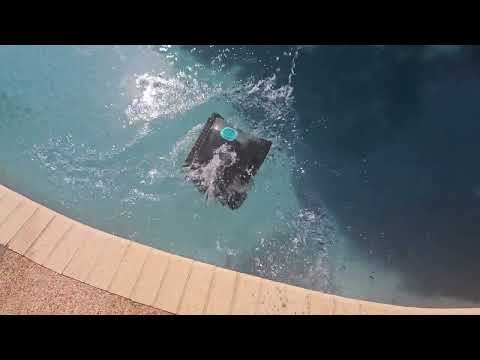
Once it reached the wall, the tracks carried it straight up. This was the key observation from the run: the Scuba S1 did not merely approach the wall and turn away. I watched it climb, briefly emerge above the waterline, then descend. Near the top of the climb, the front rollers started working the area around the waterline. That physical agitation is the action I want around algae-prone buildup, because the cleaner is doing more than gliding past the surface.
The robot then came back down, adjusted its position, and climbed again farther across the wall. I described the travel as a capital-N-like route because it was not repeatedly tracing one vertical strip. It moved across the wall as it cycled through climbs and descents, with overlap in the path. In practical terms, that is more useful than a cleaner that can climb but keeps concentrating on one narrow section.
I could also see why the tracks are central to the design. On a vertical pool surface, traction is the difference between a robot that can reach the cleaning zone and one that stays on the floor. The caterpillar-style tires gripped through multiple climbs in my in-ground pool. They also let the machine straighten itself after descending and prepare for another pass.
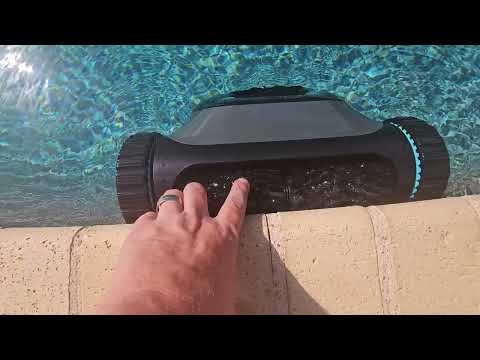
The waterline action was not a separate attachment or an extra manual step. As the cleaner rose above the water, it sensed that position and the rollers worked the surface at the top of the run. The rollers are soft, rubber/PVC-like material rather than a hard abrasive tool. I watched them agitate the buildup area while the machine moved up and down the wall. For routine grime, that is the kind of repeated contact that can take a wall task off the regular manual list.
My hands-on take on the cleaner’s layout and operation
The Scuba S1 has a practical, purpose-built layout for the jobs I saw it perform. There are the large tracked tires, front rubber brushes or rollers, drive motors at the sides, a motor on top, and a removable debris basket. The front cleaning hardware helps push debris toward the collection system while it is working, and the basket is intended for ordinary pool debris such as leaves and dead bugs.
I liked the straightforward access implied by the removable basket. A robotic cleaner is only convenient if the normal cleanup after a run is manageable, and a basket that is easy to remove is better suited to ordinary pool maintenance than a design that makes debris disposal unnecessarily fussy. I did not measure basket capacity or filtration fineness, so I cannot say how much debris it holds or how fine the filtration is. What I can say is that the basket was part of the machine’s simple, accessible layout.
The onboard mode selection also makes sense for a wall-focused product. Instead of hoping wall cleaning happens as a side effect of a floor cycle, I could explicitly choose wall mode. That is useful when the pool floor is reasonably clear but the wall and waterline have become the visual problem. It also makes it easier to match the run to the actual maintenance need rather than using the same setting every time.
For comparison, smart mode was described as splitting its approximately two-and-a-half-hour cleaning time between walls and floors. Floor mode focuses on the floor, while eco mode was described as cleaning for 45 minutes every two days during a five-day cycle. The dedicated wall mode was stated as about two hours. I used wall mode because it puts the cleaner’s time and climbing behavior where wall algae and waterline grime tend to collect.
There is an important difference between seeing a robot perform a specific cleaning behavior and assuming every pool will give it the identical route. My pool has a ledge, and that ledge prevented the Scuba S1 from coming all the way up the wall. In a pool without that interruption, the route may look different. Likewise, very high water can reduce how far the robot visibly rises above the waterline. Those are pool-fit considerations, not reasons to dismiss the observed wall climbing.
Will it remove algae without manual brushing?
For routine wall maintenance and loose waterline buildup, the action I saw is exactly what I would want from a robot. The front rollers visibly agitated the surface while the machine climbed and shifted across the wall. That repeated motion can help knock loose buildup so it can be pulled into the cleaner’s collection system rather than sitting on the wall.
I would not frame it as a magic eraser for every neglected pool. Thick, firmly attached algae is a different job from ordinary wall film, and I did not test the Scuba S1 against heavy, stubborn algae patches. I also did not test tight corners, steps, irregular wall shapes, multiple ledges, or every possible pool surface. If those areas are central to your pool, it is sensible to treat them as open questions instead of assuming the coverage will be identical.
The better use case is consistency. When a robot can climb the wall and agitate the waterline as part of regular care, it gives you a way to address buildup before it becomes a major brushing project. That does not make manual attention obsolete in every pool, but it can reduce how often you need to reach for a brush for routine wall upkeep.
Pool geometry also affects expectations at the waterline. The Scuba S1’s goal is to come out about an inch or two at the top of a run, but the exact visible reach depends on water level and obstructions. In my pool, the ledge created a clear boundary. If a particular top edge, shelf, or corner must be spotless, I would not assume a general wall-cleaning path will provide pinpoint coverage there.
+ Pros
- Cordless design eliminates pool-cleaner hose management
- Tracked tires climbed the demonstrated in-ground pool wall reliably
- Front rollers visibly agitated the algae-prone waterline area
- Repeated climbs shifted across the wall instead of staying in one strip
- Removable debris basket appears easy to access
! What to know
- A pool ledge in my test limited how far the cleaner could rise up the wall.
- Very high water levels can reduce how far the cleaner visibly comes above the waterline.
- I did not test it on heavy, firmly attached algae, tight corners, steps, or irregular pool shapes.
Modes, route pattern, and what they mean for buyers
The four mode choices give the Scuba S1 a clearer purpose than a robot that only has a general automatic setting. Smart mode is for a split floor-and-wall cleaning approach. Floor mode is for the pool bottom. Wall mode is for wall cleaning, and eco mode is a periodic schedule-oriented option. The important decision is simple: use the mode that corresponds to the part of the pool you are trying to maintain.
For algae-prone walls, wall mode is the logical selection because it keeps the session centered on the wall task. In my run, that meant watching the cleaner travel from the bottom to the wall, climb, descend, reposition, and repeat. The resulting N-like pattern and overlap were meaningful because the cleaner was moving laterally over time rather than remaining locked into one vertical path.
The stated runtimes help explain the tradeoff between modes. Smart mode divides cleaning time between floor and wall work, so it is a better general-maintenance choice when both surfaces need attention. Wall mode makes more sense when the waterline and vertical surfaces are the priority. Eco mode may be relevant to an owner who wants periodic cleaning, but it is not the setting I used for this wall-focused observation.
I would also keep the route pattern in perspective. It is a coverage strategy, not a guarantee that every inch of every pool shape receives the same contact. Ledges, transitions, corners, water height, and unusual layouts can all change what a climbing robot can reach. The evidence from my pool is that the Scuba S1 did shift across the wall and repeat its climbs. That is a strong starting point for routine coverage, with the normal pool-specific limits still applying.
Specs
| Spec | Detail |
|---|---|
| Product | Aiper Scuba S1 Cordless Robotic Pool Cleaner |
| Pool type demonstrated | In-ground pool |
| Cleaning modes | Smart, floor, wall, and eco |
| Wall-mode runtime stated | About 2 hours |
| Smart-mode runtime stated | About 2.5 hours, split between walls and floors |
| Eco mode stated | 45 minutes every 2 days during a 5-day cycle |
| Wall-cleaning hardware | Tracked tires and front soft rubber/PVC-like rollers |
| Debris collection | Removable waste basket |
Who should consider the Aiper Scuba S1?
I would consider this cleaner if you have an in-ground pool, want a cordless alternative to a hose-based cleaner, and regularly notice grime around the walls or waterline. The best fit is not someone looking for an abstract list of features. It is someone who wants a robot that I watched climb a wall, agitate the upper wall area, and move laterally as it repeated that process.
It is particularly appealing if manual wall brushing is the pool chore that gets delayed. The Scuba S1 cannot change the fact that pool walls need maintenance, but it can automate the repetitive climbing-and-agitation portion of the job. The absence of a cleaner hose is part of that convenience. I did not need to manage hose placement while the machine was working through its wall pattern.
I would also look at it if leaves, dead bugs, and similar ordinary debris are part of your routine pool cleanup. The removable basket gives that material a place to go while the tracks and front rollers handle movement and cleaning contact. I would not make a buying decision based on assumed capacity, recharge time, long-term durability, or ultra-fine filtration, because I did not test or verify those details.
Think more carefully if your pool has many shelves, multiple ledges, tight corners, unusual wall transitions, or specific spots that need precise attention. I saw one ledge limit the top of the Scuba S1’s climb in my own pool. A high water level can also change how much of the robot comes above the waterline. Those details do not erase its wall-cleaning strengths, but they should inform whether its path suits your pool layout.
Scorecard
Tracked tires climbed and repeated the wall route in my pool.
Front rollers visibly agitated the waterline area.
No cleaner hose to manage.
It shifted across the wall, though my ledge limited top reach.
Strong agitation for upkeep; heavy attached algae was not tested.
Final recommendation for pool wall maintenance
I like the Aiper Scuba S1 for the job I watched it do: climb an in-ground pool wall, agitate the waterline, descend, reposition, and repeat without a hose getting in the way. Its tracks provided the wall traction, its front rollers provided visible waterline agitation, and its route shifted across the surface rather than staying in one strip. For normal wall upkeep, that is useful automation in a place where manual work is easy to postpone.
Set expectations based on your pool instead of expecting universal coverage. My ledge limited the machine’s upper reach, and water level can affect how much it rises above the waterline. I also would not count on any robot alone for unusually stubborn, firmly attached algae when I have not tested it in that situation. But if your main goal is a cordless pool wall cleaner for routine algae-prone wall and waterline maintenance, the Scuba S1 showed me the right core behavior.
As an Amazon Associate I earn from qualifying purchases.
FAQ
Does the Aiper Scuba S1 climb pool walls?
Yes. I watched the Scuba S1 travel from the pool bottom to the wall, climb using its tracked tires, descend, reposition, and climb again. In my pool, it completed multiple wall climbs rather than staying on the floor.
Can the Aiper Scuba S1 clean the waterline?
It can work the waterline area. During my wall-mode run, the front rollers agitated the surface near the waterline as the robot reached the top of its climb. The exact reach at the top can vary with water level and pool features such as ledges.
Does this robotic cleaner need a hose?
No. The Scuba S1 is cordless, so there is no pool-cleaner hose to connect or manage during operation. That was one of the most practical benefits of the setup for me.
Is wall mode better than smart mode for algae on pool walls?
For a wall-focused job, wall mode is the more direct choice. Smart mode divides cleaning time between floors and walls, while wall mode keeps the cleaner focused on the wall-cleaning task. I used wall mode for this observation.
Will the Scuba S1 handle thick algae without brushing?
I did not test it on thick, firmly attached algae, so I cannot say how it performs on a heavily neglected wall without pre-scrubbing. The observed rollers visibly agitated routine buildup at the waterline, which supports its role as an ongoing maintenance tool.
Will it reach every ledge, corner, and step?
I did not test tight corners, steps, or irregular pool shapes. In my pool, a ledge prevented the cleaner from coming all the way up the wall, so pool geometry should be part of the buying decision.