Inground Pool Robot for Leaves: Aiper Seagull Pro
The Aiper Seagull Pro handled a real inground pool floor without babysitting, picking up leaves, small debris, and dog hair in floor-only mode.
Affiliate disclosure: As an Amazon Associate I earn from qualifying purchases. This article may contain affiliate links, which means I may earn a commission at no extra cost to you.
If leaves, tree debris, and dog hair keep settling on your pool floor, the Aiper Seagull Pro is the kind of inground pool robot for leaves that makes sense to consider. I set it to floor-only mode, lowered it into the pool, and let it work. It sank quickly, made repeated passes across the floor, turned itself around at the wall, and finished with a basket full of the material I wanted gone.
This is a product-first look at the cleaning job that matters to me most: getting settled debris off an inground pool floor without standing there guiding a manual vacuum pole. The Seagull Pro did that job in my run. It also gave me a clear reminder that convenience is not only about how the robot cleans; it is also about how comfortable you are lifting the machine into and out of the water.
A solid fit for inground-pool owners who want hands-off floor cleaning for leaves, small debris, and dog hair. I liked the straightforward mode dial, repeat-pass movement, and accessible top basket; just know that it is heavy to lower into the pool.
As an Amazon Associate I earn from qualifying purchases.
The big win here is simple: the robot cleaned the floor without me having to keep repositioning it. I still had to lower it into the pool, remove it afterward, and empty its basket, but I did not have to spend the cycle steering a hose over leaves and hair. For an owner dealing with recurring debris from trees and swimming dogs, that is the practical appeal.
| Pool type used | Inground pool |
|---|---|
| Modes shown | Auto, floor-only, wall-only |
| Cleaning task demonstrated | Floor-only debris pickup |
| Debris collected | Leaves, fine debris, dog hair |
| Basket access | Removable top lid |
How this inground pool robot handled leaves and dog hair
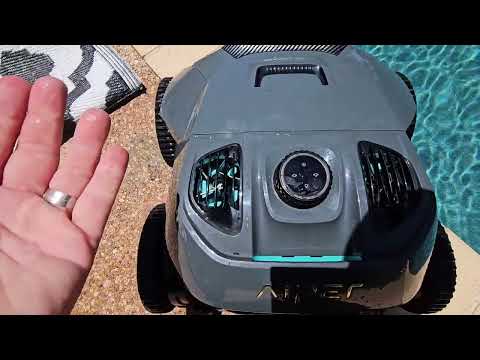
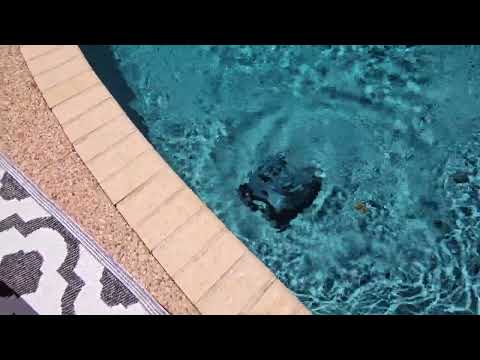
I used the Seagull Pro in an inground pool on its floor-only setting. The control dial shows three choices: auto, floor-only, and wall-only. For this run, floor-only was the sensible choice because the immediate cleanup problem was on the bottom. I turned the dial to that setting, lowered the cleaner into the water, and watched it sink quickly before beginning its run.
Once it was moving, the robot travelled in repeated back-and-forth passes across the pool floor. It eventually reached a rounded section of wall, began to travel upward slightly, recognized the change in angle, turned around, and headed back across the bottom. I liked seeing that behavior because a rounded pool side is not the same as a blunt, square edge. The cleaner did not need me to go over and move it when it encountered that transition.
That repeated movement is important for the search intent behind an inground pool robot for leaves. A leaf cleaner is not useful simply because it can move around underwater. It needs to keep returning across the area where debris settles. In my run, the Seagull Pro continued its floor pattern after changing direction rather than ending its work at the wall.
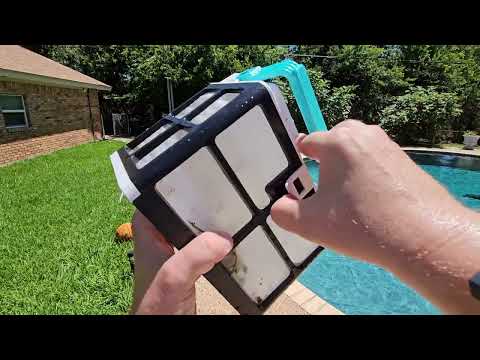
The pool is used by dogs, so dog hair is part of the normal debris load. Leaves, small particles, and material from nearby trees also make their way onto the bottom. After the cleaning cycle, the robot had parked at the side of the pool. I took it out, removed the top lid, and checked the basket. Inside were leaves, little pieces of debris, visible dog hair, and tree material.
That basket check is the most useful evidence from the run. It confirms that the cleaner did more than travel over the floor: it captured both obvious leaf debris and smaller material. Large leaves are easy to spot from the pool edge, but finer debris and pet hair can leave the water looking less tidy even when the biggest leaves are gone. The mix in the basket is why I consider the floor-cleaning result worthwhile.
Setup, mode selection, and the basket workflow
The Seagull Pro is straightforward to operate for the task I ran. The mode dial is on the unit rather than hidden behind an app menu, and its labels are easy to understand. Auto is the setting intended to divide a stated 2.5-hour cycle between floor and wall cleaning. The dedicated floor-only and wall-only settings are intended to keep the cleaner on the selected surface for the full stated cycle. I used floor-only, so my observations here are about floor pickup and navigation, not wall cleaning.
For my pool, choosing the mode first was more useful than treating every cleanup as the same job. If leaves and hair are sitting on the bottom, I want the cleaner concentrating on the bottom. A floor-only pass avoids sending it toward a different surface when the debris I need removed is plainly settled below.
The debris basket is accessed through the removable top lid. When the cycle was done, I opened that lid and could immediately see what the robot had collected. This matters in ordinary ownership because the cleanup does not end when the robot parks. You need to inspect the basket, empty the material, and get the cleaner ready for its next run. A top-access design makes that part of the routine easy to understand.
I would also plan for the physical handling. The Seagull Pro felt pretty heavy when I lowered it into the pool. That does not erase the benefit of hands-off cleaning once it is in the water, but it is a meaningful buyer consideration. If lifting a substantial robotic cleaner in and out of the pool is difficult for you, think about where you will handle it and whether you have help available when needed.
It is worth separating that handling consideration from cleaning performance. In the water, the machine took over the repetitive floor work. At the pool edge, I was still responsible for lowering it in, pulling it out after it parked, and emptying the basket. Buyers who are replacing manual vacuuming may still find that a good trade, but it is best to go in with the full routine in mind.
Why its floor behavior worked for my debris problem
I liked that the Seagull Pro made pass after pass instead of simply charging into the wall and stopping. On the rounded wall in my pool, it started upward slightly, reversed itself, and resumed moving across the floor. The rollers and wheels shown on the unit are part of that physical behavior, and the result I saw was continued floor coverage after a direction change.
The repeated crossings also fit the way pool debris accumulates. Leaves do not always land in one neat pile, and dog hair or fine tree material can be scattered across the bottom. A cleaner that returns across the floor is more relevant to that mess than one that only makes a short, isolated path. I saw multiple crossings during the run, then found the mixed debris in the basket when it was over.
The manufacturer describes its navigation as a wave-path or S-pattern approach. I observed the back-and-forth behavior across the floor, but I would not make a buying decision based on a navigation label alone. The useful point is the visible result: it moved, met the wall, changed direction, and continued cleaning the pool bottom.
The manufacturer also describes a quad-motor system and says twin motors help maintain floor contact and pull water through the cleaner for suction. Those are manufacturer claims, not measurements I independently verified. What I can say from the run is that the Seagull Pro picked up leaves, fine debris, dog hair, and tree material from this inground pool.
This distinction matters when comparing robotic pool cleaners. Marketing terms can sound impressive, but the buyer question is usually simpler: will it remove the mess I actually have? For my floor-only cycle, the basket contents give the clearest answer. It handled a normal combination of leaf debris, small particles, and dog hair rather than only one easy type of debris.
Who should consider the Aiper Seagull Pro for an inground pool?
I would look at this cleaner if you have an inground pool and your ongoing frustration is debris collecting on the floor. It is particularly relevant for pools near trees, pools that collect leaves and small organic material, and pools where dogs swim and leave hair behind. In that use case, an unattended floor run can replace a repetitive manual-vacuum task.
It also makes sense for shoppers who want a simple physical mode choice. The dial gives you auto, floor-only, and wall-only options. I appreciate that because pool maintenance changes from day to day. Sometimes the need is a floor cleanup; other times, a buyer may specifically want a different surface addressed. The presence of those modes gives the product flexibility, even though I only used floor-only in this pool.
I would be more cautious if your purchase depends entirely on wall or waterline cleaning. I did not test wall-cleaning or waterline-cleaning performance in my run, so I cannot say how it will perform in those scenarios. Likewise, I used it in one inground-pool environment, not every possible pool shape, surface, depth, or debris load.
Other practical questions remain outside what I established here. I did not independently determine the basket’s capacity, filter fineness, battery or runtime details, charging routine, durability, or long-term reliability. The exact duration of my cleaning run was not independently timed. Those details can matter for a final purchase decision, especially if your pool has unusually heavy debris or you expect frequent cleaning cycles.
Still, the basic buyer fit is clear. If the priority is a robot that can be set down in an inground pool to work the floor while you do something else, then be emptied after collecting leaves, small debris, and dog hair, the Seagull Pro delivered that core experience for me.
Floor-only mode versus auto and wall-only mode
Floor-only mode was the right setting for my run because the debris was on the bottom. The Seagull Pro stayed focused on the floor, made repeated crossings, and collected the material I checked in the basket afterward. For people whose main pool-cleaning headache is settled leaves, this is likely to be the setting used most often.
The dial also includes auto and wall-only. The manufacturer describes auto as splitting a stated 2.5-hour cycle between floor and wall cleaning, while the dedicated floor-only and wall-only modes devote the full stated cycle to their chosen surface. That is useful context when deciding which setting matches your maintenance task, but the timing is a manufacturer claim rather than a duration I independently verified.
I would choose the mode based on the visible problem rather than assuming one setting is automatically best. If the floor is leaf-covered, concentrate on the floor. If walls are your concern, wall performance is a separate question to evaluate because it was not part of my firsthand run. That is not a drawback unique to this cleaner; it is simply the honest limit of what I used and observed.
+ Pros
- Hands-off floor cleaning once it is set to floor-only mode and lowered into the pool
- Made repeated floor passes and reversed direction after reaching the pool wall
- Collected leaves, fine debris, dog hair, and material from nearby trees
- Removable top lid makes the debris basket easy to access and inspect
- Selectable auto, floor-only, and wall-only modes on the control dial
! What to know
- It felt pretty heavy to lower into the pool.
- I used floor-only mode in this pool; wall-cleaning performance was not part of my run.
- The manufacturer describes auto mode as splitting a stated 2.5-hour cycle between floor and wall cleaning.
Specifications and claims in context
The Seagull Pro shown here has rollers, wheels, a mode-selection dial, and a top lid for basket access. Those are the product details I could directly see and use. The selectable modes were auto, floor-only, and wall-only, while my practical test was a floor-only debris pickup run in an inground pool.
The manufacturer’s broader claims include a quad-motor system, incline capability regardless of pool size or depth, twin motors for continuous floor contact and suction, and a wave-path navigation approach. I would treat those as product claims rather than as promises established by my one cleaning cycle. My firsthand evidence is narrower and more useful: it sank quickly, moved in repeated floor passes, turned around at the rounded wall, parked at the side, and held collected debris in the top-access basket.
Specs
| Spec | Detail |
|---|---|
| Product | Aiper Seagull Pro |
| Mode selection | Auto, floor-only, wall-only |
| Debris access | Top lid with removable access to basket |
| Drive components shown | Rollers and wheels |
| Motor claim | Quad-motor system (manufacturer claim) |
| Auto-cycle claim | 2.5 hours split between floor and wall cleaning (manufacturer claim) |
How I scored the cleaning experience
My strongest scores are for floor debris pickup, hands-off operation, and basket access because those are the parts I directly experienced. The robot captured a mixed debris load, continued moving after meeting the wall, and made its basket simple to inspect through the removable top lid.
I scored handling lower because of the weight I felt while lowering it into the pool. Mode flexibility scores well because the dial gives clear choices, but it is not a perfect score because my firsthand run covered only floor-only mode. These scores are about the use case I had, not a claim that every pool owner will get identical results.
Scorecard
Collected leaves, fine debris, and dog hair.
Made repeated passes and reversed at the wall.
Top lid gives direct access to debris.
Auto, floor-only, and wall-only settings are shown.
Effective setup, but the unit is fairly heavy to lower in.
Frequently asked questions about this inground pool robot for leaves
Does the Aiper Seagull Pro pick up leaves?
Yes. After my floor-cleaning run, the basket held leaves along with smaller debris, dog hair, and material from nearby trees. The basket result is why I think it is a practical option for leaf debris on an inground pool floor.
Can the Aiper Seagull Pro pick up dog hair?
It collected visible dog hair in the inground pool I used. Dogs swim in that pool, so hair was part of the normal debris mix rather than something added for a special test.
Does it clean an inground pool floor by itself?
In floor-only mode, I lowered it into the pool and let it run unattended. It moved in repeated passes across the floor, reversed after encountering the rounded wall, continued cleaning, and parked at the side when finished.
What cleaning modes does the Aiper Seagull Pro have?
The control dial shows auto, floor-only, and wall-only modes. I used floor-only mode. The manufacturer describes auto as dividing a stated 2.5-hour cycle between floor and wall cleaning, with the dedicated modes focused on their selected surface.
Is the Aiper Seagull Pro easy to empty?
The top lid removes to provide access to the debris basket. After the cycle, I opened it, saw the collected leaves, hair, and smaller debris, and could dump the material out.
Is the Aiper Seagull Pro heavy?
Yes. It felt pretty heavy when I lowered it into the pool. That is the main practical caveat I would consider before buying, particularly if lifting equipment at the pool edge is a concern.
Does the Aiper Seagull Pro clean walls and the waterline?
It has a wall-only setting and an auto setting that the manufacturer says includes floor and wall cleaning. I did not test wall or waterline cleaning in my floor-only run, so I cannot say how it will perform on those surfaces.
My final take
The Aiper Seagull Pro did the important part well in my pool: it handled unattended floor cleaning and collected leaves, small debris, and dog hair in its basket. The mode dial is simple, the top-access basket is convenient to inspect, and its reversing behavior kept the floor run moving after it met the rounded wall.
If you are tired of manually vacuuming leaf debris off an inground pool floor, this is a practical robotic option with a demonstrated result behind it. Just be ready to lift a substantial machine when it is time to put it in or take it out, and treat wall and waterline cleaning as a separate consideration from the floor-only run I used.
As an Amazon Associate I earn from qualifying purchases.