Cordless Inground Pool Robot: Does KliBot Climb Walls?
The KliBot cordless inground pool robot climbed my pool wall, reversed away from steps, and offers useful mode choices. Here’s who it fits.
Affiliate disclosure: As an Amazon Associate I earn from qualifying purchases. This article may contain affiliate links, which means I may earn a commission at no extra cost to you.
If you are shopping for a cordless inground pool robot, wall climbing is one of the first things worth checking. The KliBot In-Ground Pool Vacuum Cleaner handled the core movement jobs I wanted to see in my first run: it crossed the floor, climbed a wall, turned itself around, and reversed when it met my pool steps. That is a promising starting point for a rechargeable robot intended to help with routine pool upkeep.
The standout feature is not simply that it is cordless. KliBot gives you four mode choices, including a classic setting that sends it across the floor, up a wall, and back in the other direction. That lets you choose between a floor-focused run, a wall-focused run, a mixed run, or the floor-and-wall pattern I used. It also means the buying decision is less about expecting one robot to do every pool-cleaning task and more about deciding whether its demonstrated coverage fits the areas you want help with.
A sensible cordless inground pool robot for routine floor-and-wall runs if you want selectable modes and do not expect it to clean pool steps. I liked the classic floor-to-wall pattern and its step reversal; runtime and debris pickup still need to be judged over longer use.
As an Amazon Associate I earn from qualifying purchases.
Does this cordless inground pool robot actually climb walls?
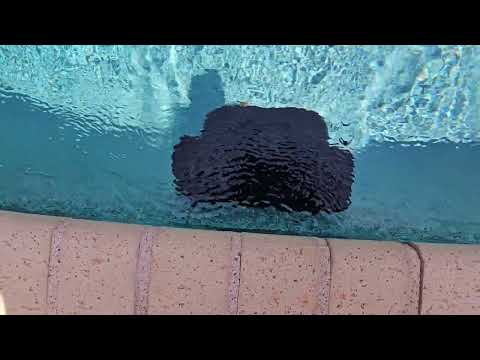
Yes. In my initial classic-mode run, the KliBot traveled across the pool floor, climbed a wall, turned, and headed back in the opposite direction. That sequence is the most useful firsthand result from this first look because it confirms that the robot made the floor-to-wall transition in my pool rather than staying on the bottom.
For an inground-pool owner, that transition matters. A cordless robot can be convenient to deploy, but convenience alone is not much help if the unit only circulates around one area of the floor. Here, I saw the KliBot establish its path on the floor, reach the vertical surface, climb it, and change direction for another pass. The large caterpillar-style tires are part of the design that stood out during my first look, and they appear intended to provide the traction needed for movement around the pool.
It also climbed toward the waterline and emerged slightly above the water. My pool was extremely full after a storm, though, so I could not get a normal view of how far it would rise above the water at a typical operating level. I did see it sense the surface and begin its turn on the wall. That supports its wall-climbing behavior, but I would not turn that brief observation into a promise about complete waterline cleaning at every water level.
This distinction matters when comparing pool robots. “Wall climbing” can mean a robot gets onto the wall, while “waterline cleaning” is a more specific expectation about how high it reaches and how consistently it works that band around the pool. I saw the first behavior clearly. Because of the unusually high water, I only got a limited view of the second.
KliBot cleaning modes: why classic mode is the draw
KliBot has four operating choices. That gives this cordless inground pool robot more direction than a single-setting cleaner that makes every coverage decision for you. The choices are useful because a pool does not always need the same type of attention. Some days the floor is where the visible debris settles; on others, the walls are the area you want the robot to prioritize.
- Mixed wall/floor mode: This divides the available battery use between walls and floors.
- Floor-only mode: This directs the available battery time toward the pool floor.
- Wall-only mode: This prioritizes wall cleaning.
- Classic mode: This uses a back-and-forth floor pattern, followed by a wall climb, turn, and return in the other direction.
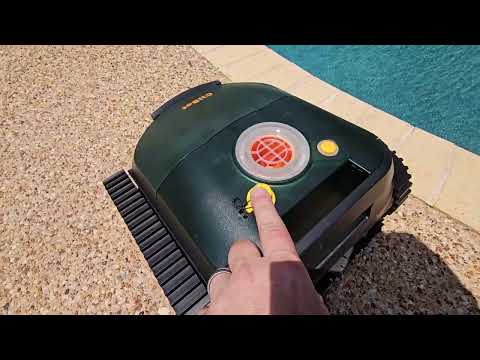
I used classic mode for the pool run. I activated it by holding the control button until it beeped and the mode indicator illuminated. Once it was in the water, the robot sank, took a few seconds to fill with water, and began moving in the direction its front rollers landed. From there, I could watch the classic pattern develop: floor travel, a wall climb, a turn, and travel back across the pool.
Classic mode is the setting that makes the most sense to me for regular floor-and-wall maintenance. It is a deliberate-looking pattern rather than simply choosing an isolated cleaning surface. If the goal is to keep up with the usual material on the floor while also putting some attention on the walls, it is the mode I would start with based on this initial use.
The other settings still have a clear purpose. Floor-only is the straightforward choice when the bottom is the immediate concern and you want the robot’s effort directed there. Wall-only is the more logical option when the floor looks acceptable but the walls need attention. Mixed mode offers a split approach. I did not run full cleaning cycles in each of those settings, so I cannot compare their total coverage or runtime. What I can say is that the modes were described clearly, and classic mode was activated and used during my first run.
First look at the KliBot’s practical design
Before putting it in the pool, I could readily identify the parts that matter for everyday ownership. The KliBot has a debris basket, large caterpillar-style tires, broad cleaning brushes at the front, and a charging port. The basket and charging connection were externally accessible in my first look, which is important because a pool robot needs to be reasonably straightforward to empty and recharge between runs.
The front brushes are intended to contact the floor and walls as the robot moves. The tires are visibly much more substantial than small, basic wheels, which fits the kind of floor-to-wall travel I saw. I would not draw a long-term durability conclusion from appearance alone, but the layout makes practical sense for the cleaning job this robot is designed to do.
There is also a useful simplicity to the startup behavior. After I placed the unit in the water, it sank and filled with water for a few seconds before starting its route. The direction of the front rollers when it landed determined the initial direction of travel. That is worth remembering when you lower it into the pool: its first path is influenced by how it settles, not by a remote steering command.
For buyers who want a cordless cleaner specifically to avoid dealing with a hose vacuum during routine maintenance, this basic layout is relevant. The robot still has ordinary ownership tasks—charging, emptying its basket, and choosing the appropriate mode—but the setup I observed was focused on placing the unit in the water and letting it begin its route.
| Pool type | Marketed for inground pools |
|---|---|
| Power | Cordless rechargeable |
| Cleaning modes | Mixed, floor-only, wall-only, and classic |
| Wall climbing | Climbed a wall in my classic-mode run |
| Step behavior | Recognizes steps and reverses; does not climb them |
| Runtime claim | Up to 210 minutes claimed |
How the KliBot handles pool steps
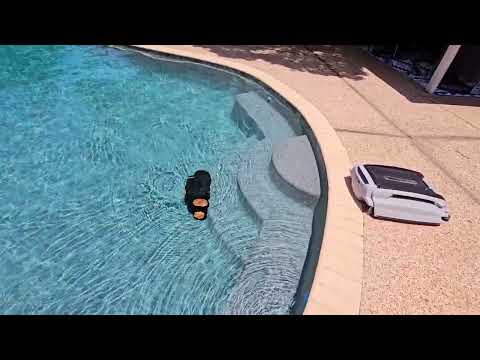
Do not buy this model expecting it to climb or clean pool steps. It is not made for that job. When the KliBot reached my steps, it recognized the obstacle and reversed direction rather than trying to crawl up them.
I consider that a useful navigation behavior for its intended route. A robot spending its run repeatedly trying to force its way up steps would waste time and battery. Instead, the KliBot turned away and continued its pattern. That makes it better suited to maintaining the open floor and reachable wall sections than to replacing every manual pool-cleaning tool.
Step treads, tight corners, and other areas a wheeled robot cannot physically reach still need another cleaning method. That is a normal limitation of this type of pool robot, but it should be part of the purchase decision. If your main cleaning frustration is a broad floor and wall area, KliBot’s demonstrated behavior is relevant. If the steps are the area you most need cleaned, this is not the right expectation to bring to it.
What I saw in the initial pool run
The first run was uncomplicated. The unit entered the water, sank, filled with water, and started moving. In classic mode, I watched it travel on the floor, rise up the wall, turn around, and repeat the general back-and-forth idea. It also reversed at the steps instead of getting hung up there.
Those are meaningful observations for someone considering a cordless inground pool robot for regular upkeep. The KliBot did not merely sit on the floor. It demonstrated travel, wall climbing, turning, surface sensing near the waterline, and a response to the step obstacle. Combined with four selectable modes, that gives it more flexibility than a basic one-pattern robot.
At the same time, this was an initial run, not a complete long-term evaluation. I did not measure a full battery cycle. I did not establish how consistently it covers the entire pool over a full cycle. I also did not measure pickup results with leaves, sand-sized debris, or other debris types. The listing advertises up to 210 minutes of runtime, but I did not measure runtime myself. Treat that as a manufacturer claim rather than my result.
I also cannot say how it will perform on every pool surface, shape, slope, or water level. My wall-climbing observation comes from my own pool and the conditions present that day. The high post-storm water level was especially relevant near the waterline because it limited the usual amount of exposed wall available for the robot to emerge above the water.
Who this KliBot pool vacuum suits best
I would consider this model if you have an inground pool, want a rechargeable cleaner, and value the option to target floors, walls, or a combined route. The classic setting is particularly appealing if your normal goal is a recurring floor-and-wall pass instead of focusing on just one isolated area.
It is also a reasonable fit for someone who understands the robot’s coverage boundaries. It can navigate across the floor and climb a wall. It will reverse at pool steps rather than climb them. It can approach the waterline, but the actual amount of exposed upper wall it reaches can be influenced by the water level. If waterline attention is important to you, keeping the pool at its normal operating level gives a more typical condition than the unusually full pool I had during this run.
The mode selection can help buyers make a more purposeful choice before each run. Use floor-only when the bottom is the immediate concern. Use wall-only when you want to prioritize the vertical surfaces. Use mixed mode when you want to divide time between both, or try classic mode when the floor-to-wall travel pattern is the behavior you want. The ability to select among those options is the clearest practical advantage I saw.
I would be more cautious if your buying decision depends on proven extended runtime, quantified debris pickup, complete coverage on a particular pool shape, or long-term reliability. I did not test those questions, so I cannot answer them from this first use. Buyers with heavy leaf loads, fine grit concerns, unusually shaped pools, or a need for stair cleaning should make sure those requirements are addressed before relying on this robot as their whole cleaning plan.
Buyer expectations before choosing a cordless pool robot
A cordless robot can make routine maintenance feel less involved than pulling out a manual vacuum setup, but it is still best viewed as a helper with a defined coverage area. In KliBot’s case, the observed strengths are its mode choices, floor travel, wall climb, and reversal when it detects steps. Those are the things I would use to decide whether it matches my pool-maintenance routine.
The important limitation is equally clear: a robot that reverses at steps does not clean the steps. That is not a reason to dismiss it if your main need is floor and wall maintenance, but it is a reason not to expect a fully hands-off result in every part of the pool. The same goes for the waterline observation. I saw it climb toward the surface and emerge slightly above it, but my high water level prevented a typical look at that area.
For routine use, the strongest case is a buyer who wants to choose a cleaning emphasis rather than settle for a single automatic pattern. KliBot offers a floor-only option, wall-only option, a split mixed setting, and the classic floor-to-wall route. That flexibility is more valuable when you actually plan to use it: choosing the mode based on the part of the pool that needs attention makes better use of a cordless run.
Key KliBot pool vacuum details
The KliBot is marketed for inground pools and uses a cordless rechargeable design. It has front cleaning brushes, caterpillar-style traction tires, an externally accessible debris basket, and an external charging port. Its four selectable modes are the clearest functional feature: mixed wall/floor, floor-only, wall-only, and the classic floor-to-wall pattern I used.
The advertised runtime is up to 210 minutes. Since I did not measure runtime, battery performance remains an open question rather than a confirmed result. The same applies to full-cycle coverage, debris capacity, charging time, maintenance frequency, and long-term reliability. Those are reasonable questions to ask before treating any pool robot as the primary solution for all pool cleaning.
+ Pros
- Four selectable modes for floor, wall, mixed, or classic floor-to-wall cleaning
- Climbed a pool wall during my initial classic-mode run
- Recognized pool steps and reversed instead of getting stuck trying to climb them
- Accessible debris basket and external charging port
- Large caterpillar-style tires and front cleaning brushes
− Cons
- Does not climb or clean pool steps
Specs
| Spec | Detail |
|---|---|
| Product | KliBot In-Ground Pool Vacuum Cleaner |
| Pool compatibility | Marketed for inground pools |
| Power design | Cordless rechargeable |
| Cleaning modes | Four selectable modes |
| Mode options | Mixed wall/floor, floor-only, wall-only, classic |
| Traction | Caterpillar-style tires |
| Brushes | Front cleaning brushes |
| Debris access | Externally accessible debris basket |
| Charging | External charging port |
| Advertised runtime | Up to 210 minutes |
Scorecard
Crossed the floor and climbed a wall in classic mode.
Four modes let you focus on floors, walls, or both.
Reversed direction after recognizing pool steps.
Debris basket and charging port were easy to identify.
It intentionally does not climb pool steps.
Frequently asked questions
Does the KliBot pool robot climb walls?
It did in my pool. In classic mode, I watched it move across the floor, climb a wall, turn around, and travel back in the opposite direction. That confirms floor-to-wall movement in my initial run, though it does not establish coverage results for every pool shape or surface.
Can the KliBot clean pool steps?
No. It is not made to climb steps. When it encountered my steps, it recognized the obstacle and reversed direction. That helps it avoid getting stuck trying to climb them, but the step treads still need separate cleaning.
What does classic mode do on the KliBot?
Classic mode uses a floor-to-wall-to-return pattern. I activated it by holding the control button until the unit beeped and the mode indicator illuminated. During my run, it crossed the floor, climbed a wall, turned, and headed back the other way.
How long does the KliBot battery last?
The listing advertises up to 210 minutes. I did not measure a full runtime cycle, so that is a manufacturer claim rather than a firsthand runtime result. I also did not compare battery duration across the four cleaning modes.
Does the KliBot clean the waterline?
It climbed toward the waterline and came slightly above the water in my pool. Because the pool was unusually full after a storm, I could not judge normal waterline reach or complete waterline-cleaning results under typical conditions.
Final recommendation
The KliBot earned a cautious thumbs-up from me as a cordless inground pool robot for routine floor and wall cleaning. It traveled, climbed, turned, and avoided the steps when it needed to. Add in the four mode choices, and it has useful flexibility for someone who wants to direct a run toward floors, walls, or both.
Keep expectations realistic. It is not a stair climber, and I would not make a runtime, complete-coverage, or debris-pickup promise based on my first run. But if the problem you want to solve is keeping the main floor and walls on a regular schedule without using a hose vacuum every time, KliBot showed the right basic movement behavior in my pool.
As an Amazon Associate I earn from qualifying purchases.