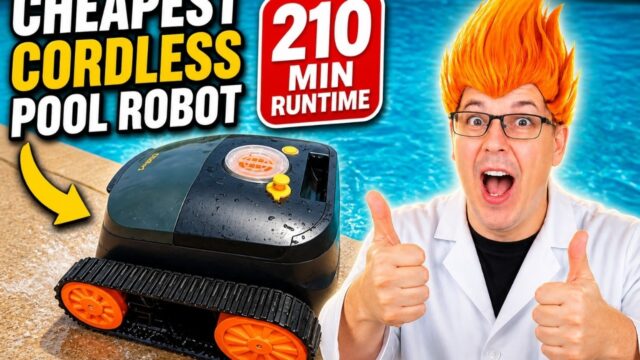
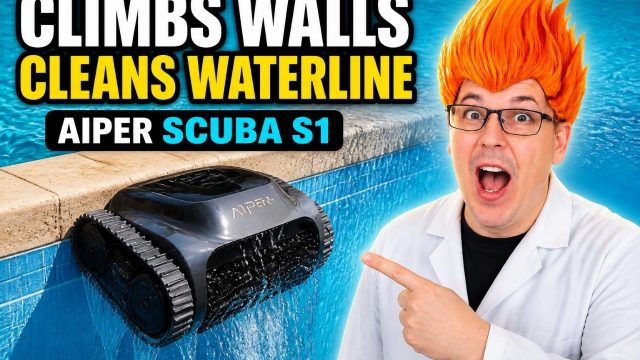
Cordless Robotic Pool Cleaner for Inground Pools: X5 Review
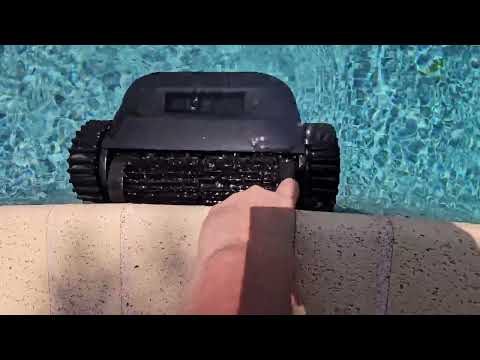
The Pondee X5 climbed my inground pool wall and worked the waterline in Classic mode. Its tracked drive and soft brushes are the main story.
Affiliate disclosure: As an Amazon Associate I earn from qualifying purchases. This article may contain affiliate links, which means I may earn a commission at no extra cost to you.
If you are shopping for a cordless robotic pool cleaner for inground pools, the important question is whether it can do more than roam the floor. I put the Pondee X5 into its Classic mode and watched it travel across the pool floor, climb the wall, reach the waterline area, descend, turn, and repeat. That floor-to-wall movement is the useful part of this machine. A floor-only robot can help with settled debris, but a robot that makes regular wall and waterline passes addresses a different part of routine pool care.
The X5 uses caterpillar-style tracks and large, soft sponge-like brushes. In my inground pool, the tracks got it up the wall and the brushes made contact at the waterline. I also liked that the mode selection happens on the unit itself; there was no app setup involved in choosing the pattern I used. The tradeoff is that the most useful mixed setting, Classic mode, is not the most obvious one at first.
This review is focused on what I observed in the pool: the wall climb, the short waterline work, the repeating Classic-mode path, and the controls needed to select it. I did not separately establish heavy-leaf pickup, fine-sediment filtration, algae removal, basket capacity, recharge time, long-term reliability, stair cleaning, corner coverage, or results on every pool finish. Those are worthwhile buyer questions, but they were outside this use.
A solid option for inground-pool owners who want a cordless cleaner that can travel from the floor up the wall and briefly work the waterline. The hidden Classic mode is worth using, but its full debris-handling and long-term performance remain unknown.
As an Amazon Associate I earn from qualifying purchases.
Why an inground-pool robot needs wall coverage
Pool floors collect grit, leaves, and whatever arrives with wind or swimmers. That is the obvious cleaning job. The wall and waterline can need attention for a different reason: everyday buildup from use, including sunscreen and body oils, tends to collect around the wet transition zone. It can start to look scummy or ring-like even when the floor is relatively clean.
That is why wall climbing matters when comparing a cordless robotic pool cleaner for inground pools. The feature is not just about seeing a robot drive vertically. It determines whether the cleaner can include the wall and waterline area in its regular route rather than leaving those surfaces for a separate manual pass.
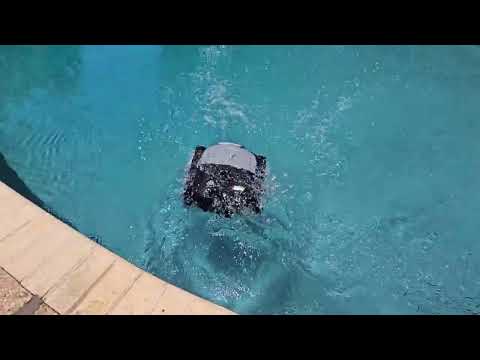
I watched the X5 meet the wall, climb on its tracks, come slightly above the water surface, scrub at the waterline, and return to the floor. My water level was very high, so it did not rise far out of the water. It got out just enough to work the line. That distinction is important for setting expectations: this is waterline-area cleaning, not a machine intended to scrub dry tile high above the pool water.
The practical benefit is repeated attention to the surfaces that a floor-only cleaner does not reach. It does not mean a robot replaces every manual pool-cleaning task or can be assumed to solve every type of buildup. It does mean the floor, wall, and waterline can be part of one demonstrated travel pattern.
| Pool type | Inground pools |
|---|---|
| Power type | Cordless rechargeable |
| Drive system | Caterpillar-style tracks |
| Cleaning modes | Auto, Floor, Wall, Classic |
| Standout function | Floor-to-wall travel with waterline-area contact |
My Pondee X5 Classic-mode experience
Out of the box, the X5 is straightforward to identify. I handled the wide caterpillar-style tracks, the large brush elements, the debris-basket area, the covered charging port, and the mode controls. The tracks are central to the design because they are the hardware that carried the cleaner from the pool floor onto the wall in my use.
I selected Classic mode, placed the cleaner in the pool, and watched it sink to the bottom. Once it reached the floor, it moved in the direction of its brushes. It traveled to the wall, climbed upward, worked briefly at the waterline, then came down, crossed the floor, turned, and headed back the other way. The pattern repeated rather than separating floor cleaning and wall cleaning into two large blocks of time.
That repeating route is why I would choose Classic mode for normal maintenance in an inground pool. A mixed route makes sense when the goal is broad routine coverage: some attention below, some on the wall, then another pass. If the visible problem is specifically on the floor or specifically on the walls, the dedicated settings may be more relevant. But for a standard upkeep run, the alternating pattern was the standout feature I saw.
The brush material also stood out. The brushes are soft and sponge-like rather than minimal hard contact strips. At the waterline, they appeared to provide more cleaning action than some similarly designed units I have encountered. That matters because reaching the wall is only part of the job; the cleaner also needs useful contact once it gets there.
My pool’s high water level affected the visible waterline pass, not the basic climbing behavior. The X5 came out of the water only slightly, recognized that point in its route, and began scrubbing before going back down. A buyer should keep that geometry in mind rather than expecting a cleaner to travel substantially above a very full pool’s surface.
The hidden Classic mode is the key control detail
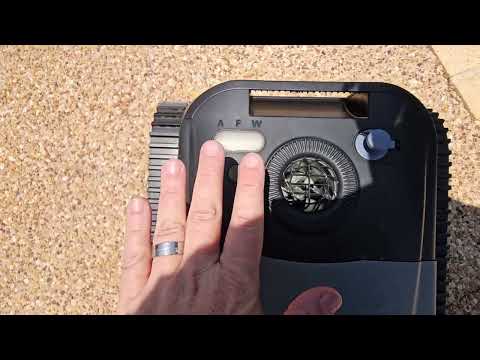
The X5 has Auto, Floor, Wall, and Classic modes. The labels for Auto, Floor, and Wall are easy to understand. Auto divides the stated operating time between walls and floors: the first half on walls and the second half on floors. Floor mode is intended to spend its time on the floor, while Wall mode is intended to spend its time on walls.
Classic mode is different. Instead of splitting the session into a wall portion and a floor portion, it follows the mixed floor-to-wall pattern I used: cross the floor, climb, work at the waterline briefly, descend, and continue across the pool. For my use, that was more appealing than waiting for one half of the cleaning period to end before the robot switched surfaces.
The catch is that Classic is hidden behind the indicator lights. I held the mode control until Auto, Floor, and Wall were all illuminated. All three lights on means Classic mode. It is not difficult after you know it, but it is not immediately intuitive from a quick look at the controls.
Before putting the X5 in the pool for a mixed cleaning pass, I would check those three indicators. If you bought this model because its floor-to-wall movement is the main appeal, selecting the intended mode matters more than simply turning it on and assuming every surface will be included in the same way.
There is also a basic charging precaution worth keeping in the routine: make sure the charging port is dry before connecting the charger, and leave its cover in place. Water and a charging connection are not a combination to handle casually.
Which X5 mode suits the cleaning job?
Classic mode: I would use this for ongoing maintenance when I want a single run to include the floor, walls, and waterline area. It is the mode I selected, and the observed route repeatedly connected those surfaces.
Floor mode: This is the focused choice when the mess is visibly concentrated down low. Settled dirt, windblown debris, and ordinary grit are the type of pool-floor problem this setting is intended to prioritize. I did not separately run Floor mode, so I cannot compare its cleaning results with Classic mode.
Wall mode: This is the setting to consider when the walls need the greater share of attention. It may be useful after heavy pool use or when visible waterline buildup is the priority. I did not separately test Wall mode, but the unit’s tracked wall climb and brush contact were demonstrated in Classic mode.
Auto mode: Auto is the simpler divided-time approach. It is intended to spend the first half of its stated operating time on the walls and the second half on the floor. That differs from Classic mode’s repeated transitions between surfaces.
I described the cleaner as operating for up to three hours depending on mode. I did not independently time a full charge cycle, so I would treat three hours as the stated mode behavior rather than a timed runtime result from my pool. Battery duration can be a deciding factor for a large pool, but the source here supports the movement pattern more clearly than a full-session runtime measurement.
+ Pros
- Tracked drive climbed the demonstrated inground-pool wall
- Classic mode combines floor, wall, and waterline-area passes
- Soft sponge-like brushes provide substantial contact at the waterline
- Onboard indicators provide Auto, Floor, Wall, and Classic modes
! What to know
- Classic mode is the all-three-lights setting, so it is less obvious than the other modes.
- A very high pool water level can limit how far the cleaner rises above the waterline.
- Keep the charging port dry before charging and leave its cover in place.
Who should consider this cordless robotic pool cleaner for inground pools?
I would look at the X5 if wall cleaning feels like a separate chore from vacuuming the floor. Its demonstrated strength is movement: it can sink to the floor, travel toward a wall, climb, work around the waterline, descend, and continue without a cord trailing through the pool.
It is most relevant for an inground-pool owner who wants a cordless robot with a mixed cleaning option and onboard controls. The track system, soft brush material, and Classic route work together toward that use case. The debris-basket area is onboard as well, although I did not establish its capacity or how it handles different debris types.
I would also consider it for ordinary waterline film associated with swimmers, sunscreen, and day-to-day use. The soft brushes gave the waterline pass a more purposeful cleaning contact than a robot that simply reaches the wall and turns around. Still, I would not treat the observation as a claim that it will remove every form of buildup or algae in every pool.
It is less of a straightforward recommendation for someone buying strictly for heavy leaves, very fine sediment, stairs, tight corners, unusual pool surfaces, or a known algae problem. I did not test those conditions, so I cannot say how the X5 performs in them. Buyers with one of those needs should make sure the cleaner’s established capabilities fit the specific job rather than relying only on its wall-climbing behavior.
Waterline performance is the practical selling point
For me, the waterline attention is what makes the X5 more interesting than a basic floor helper. Floor cleaning is an expected task for a robotic pool cleaner. The wall climb and brief waterline work are what extend the routine beyond the bottom of the pool.
During my use, the X5 made short waterline passes rather than staying there for an extended period. Each time it reached the top of its climb, it spent a couple of seconds working at the line before descending. That approach fits the Classic pattern: repeated short contacts woven into a broader pool route.
The high water level in my pool limited how far the robot could emerge, and that is a useful real-world caveat. It reached the line and scrubbed it, but it was not positioned to clean a large area of exposed wall. Keep the water at its normal operating level and view the X5 as a cleaner for the wet waterline transition, not for dry surfaces well above it.
The name in the supplied material is not completely consistent: I refer to it as the Pondee X5, while other supplied references use Pandi U and PI X5. Because the observed design and X5 model reference align, I have kept the review centered on the X5, but I would verify the exact listing and model details before ordering.
Specs
| Spec | Detail |
|---|---|
| Product | Pondee X5 cordless robotic pool vacuum |
| Recommended pool type | Inground pool |
| Drive | Tracked, caterpillar-style drive system |
| Brushes | Large soft, sponge-like brush elements |
| Modes | Auto, Floor, Wall, and Classic |
| Classic-mode pattern | Floor travel, wall climb, waterline-area pass, and descent |
| Debris collection | Onboard debris-basket area |
| Charging | Covered charging port; port should be dry before charging |
What remains unknown before buying
The X5 gave me a clear answer on one important question: it climbed my demonstrated inground-pool wall and worked at the waterline in Classic mode. It did not answer every purchase question. I did not independently establish full-charge runtime, recharge time, basket capacity, filtration fineness, long-term reliability, or cleaning performance with heavy debris and fine sediment.
I also did not separately run Auto, Floor-only, and Wall-only modes. Their intended behavior is clear from the onboard settings, but only Classic mode was the demonstrated cleaning pattern in this use. That does not make the other modes irrelevant; it simply means I would not overstate their results.
These limits should help narrow the buyer decision. Choose the X5 for the observed combination of cordless operation, tracked wall climbing, waterline-area brush contact, and a mixed floor-and-wall route. If your purchase depends on one untested scenario, such as a leaf-heavy pool or fine filtration requirement, get confirmation on that specific need before making it the deciding model.
Scorecard
Climbed the demonstrated pool wall on its tracks.
Reached and scrubbed the waterline area in Classic mode.
Four onboard choices cover floor, wall, and mixed patterns.
Classic mode works well but is not immediately obvious.
Useful mixed floor-and-wall pattern for regular inground-pool care.
Frequently asked questions
Does the Pondee X5 climb pool walls?
Yes. I watched it reach an inground-pool wall, climb it on its tracks, work at the waterline area, and descend to the floor. The climb was part of the Classic-mode pattern I used.
How do you activate Classic mode on the X5?
Hold the mode control until the Auto, Floor, and Wall indicators are all illuminated. The all-three-lights-on setting is Classic mode. Check the lights before deployment if you want the mixed floor-and-wall pattern.
What does Classic mode do?
Classic mode runs a repeating route: it travels across the floor, climbs the wall, briefly works at the waterline area, descends, and continues across the pool. It differs from Auto mode, which is intended to divide time between walls and floors.
Can the X5 clean above the waterline?
It can work at the waterline area. In my very full pool, it emerged only slightly above the surface, which limited its reach above the line. I would not expect it to clean dry tile well above the water.
How long does the X5 run?
The stated mode behavior is up to three hours. I did not independently time a complete charge cycle, so I cannot provide a measured runtime from my pool.
What should I do before charging the cleaner?
Make sure the charging port is dry before charging and leave the port cover in place. That is a simple but important part of handling a cordless pool cleaner safely.
Final recommendation
The Pondee X5 is worth considering when the goal is a cordless robotic cleaner that does more than cruise the deep end. I liked the track-driven wall climb, the Classic floor-to-wall pattern, and the soft brush contact at the waterline. Those are the practical, observed reasons to consider it for an inground pool.
The hidden Classic setting is the one annoyance. Learn the all-three-lights method once, then it becomes a simple pre-pool check. For an inground-pool owner who wants the floor, walls, and waterline area included in a more regular cleaning rotation, the X5’s demonstrated setup makes sense. Just keep the untested debris, filtration, runtime, and durability questions in perspective when deciding whether it fits your pool.
As an Amazon Associate I earn from qualifying purchases.