Cordless Inground Pool Vacuum for Leaves: Clybot Review
The Clybot cordless robotic pool vacuum picked up leaves, dog hair, bugs, rocks, and tree debris from my inground pool floor. Its simple rear basket is the standout.
Affiliate disclosure: As an Amazon Associate I earn from qualifying purchases. This article may contain affiliate links, which means I may earn a commission at no extra cost to you.
The Clybot Inground Pool Vacuum Cleaner did the job I wanted it to do: it picked up a messy mix of leaves, dog hair, dead bugs, rocks, and tree debris from the floor of my inground pool. That is the real test for a cordless inground pool vacuum. Not fancy marketing. What comes out of the basket.
A practical cordless inground pool vacuum for routine floor debris, especially leaves and pet hair. I liked the easy-clean rear basket and the amount it collected, but floor mode is for floors—not walls or the waterline.
As an Amazon Associate I earn from qualifying purchases.
I ran it in floor-only mode in the deep end of a kidney-bean-style pool. It sank, started moving, worked through the curved wall transition, and parked against the sidewall when the cycle was done. It is a straightforward robot for a straightforward maintenance problem: debris sitting on the pool floor.
| Type | Cordless robotic cleaner for inground pools |
|---|---|
| Best demonstrated use | Routine pool-floor debris pickup |
| Cleaning mode used | Floor-only mode |
| Debris access | Rear removable rinse-out basket |
| Advertised runtime | Up to 210 minutes |
| Observed debris | Leaves, dog hair, bugs, rocks, and tree debris |
Who this cordless inground pool vacuum is for
This one makes the most sense for an inground-pool owner who wants to reduce manual vacuuming between bigger cleanups. If your floor regularly collects leaves, pet hair, insects, small rocks, and debris from nearby trees, that is exactly the kind of mess I found in its basket.
It is also a good fit if you prefer a cordless drop-in cleaner over dragging a hose, booster setup, or a long power cable around the deck. Charge it, choose a mode, lower it into the pool, and let it go. Simple is good when the pool needs attention every few days.
But match the mode to the job. I selected floor-only mode, so this review is mainly about floor cleaning. If your main issue is a dirty waterline or walls, do not assume floor mode solves that problem. It doesn’t.
My first run with the Clybot pool vacuum
I used the Clybot in the deep end of my inground pool, where there were visible leaves on the bottom. The pool has a kidney-bean shape and a bowl-like transition rather than a sharp, vertical wall all the way around. That shape matters with any robot. A rectangle is easy. Curves make the machine think a little harder.
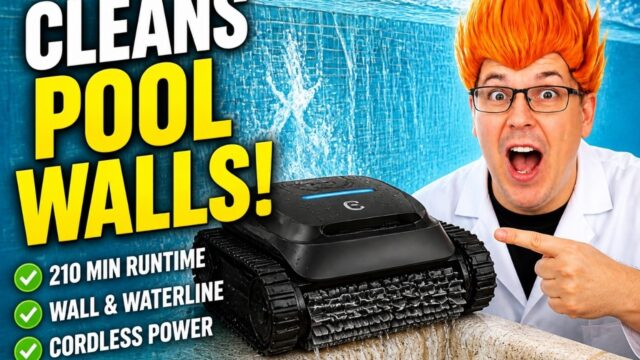
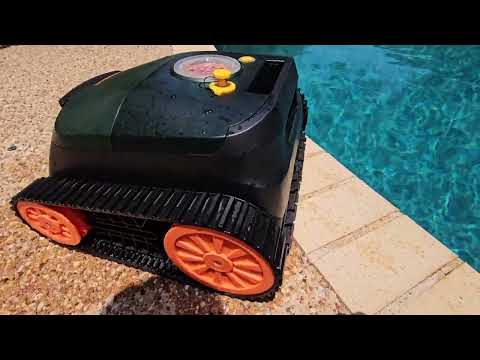
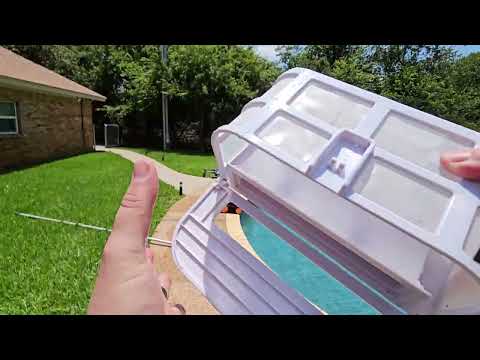
Before putting it in, I looked over the hardware. The big treaded wheels reminded me of little bulldozer tires, and the large front brushes are there to pull debris inward while agitating material on the surface. That brush-and-wheel setup is important for leaf cleanup. A robot needs to get over scattered debris before it can collect it.
I selected the floor-only setting by its indicator light, then dropped the unit into the water. It sank to the bottom and began moving in the direction of its rollers. No hose to prime. No cord to manage. That is the appeal of this type of cleaner.
On the curved section of my pool, it began moving upward before recognizing the transition, stopping, turning itself around, and heading back down. That is not surprising in a bowl-style pool. Without a distinct vertical wall, the robot can start climbing before its navigation decides it needs to reverse.
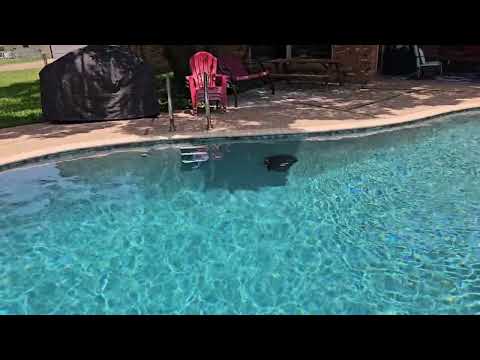
How it handled an irregular pool shape
The Clybot’s cleaning pattern was basically back and forth: move, meet the pool boundary or transition, turn, and run another pass. In an irregular kidney-bean pool, those passes will not overlap with machine-like precision every time. That is just geometry. A curved pool can create odd lanes that a robot will revisit differently than a rectangular pool.
Still, I liked that it recognized the upward transition and corrected itself instead of continuing to climb. It turned around and returned to the floor, which is where I had told it to work.
For routine debris pickup, I would view this as a maintenance robot, not a magic wand. Let it make its passes, then check the floor in the areas that collect the most debris in your pool. If you have a sharp corner, steps, tight benches, or a highly unusual shape, expect those areas to need their own attention from time to time. I did not use it in those pool layouts, so I cannot tell you how it handles them.
The basket is the part I really liked
After the cleaning cycle, the Clybot was parked against the sidewall. I pulled it out, let the water drain back into the pool, and opened the rear basket area.
This is where the result becomes obvious. Inside, I found leaves, a big pile of dog hair, dead bugs, rocks, and other debris that had blown or fallen in from the trees. That is a useful mix to see because it is not just one easy type of debris. Leaves can be bulky, dog hair can be stringy, and rocks add weight. The basket had collected all of it.
Cleanup was simple. The basket opens so debris can be shaken out, then rinsed. I snapped it back together, reinstalled it in the robot, and put the cleaner back on charge. No complicated filter surgery. For a pool robot you need to empty often during leaf season, that matters more than people think.
+ Pros
- Collected leaves, dog hair, dead bugs, rocks, and tree debris in the demonstrated floor-cleaning cycle
- Large front brushes and treaded wheels are built for moving over and pulling in floor debris
- Rear basket was easy to remove, empty, rinse, reassemble, and reinstall
- Turned itself around and headed back down after moving onto a curved pool-wall transition
- Floor-only mode directs the cleaning cycle toward floor debris
− Cons
- May partially climb a rounded or bowl-style wall transition before recognizing it and reversing
- Back-and-forth passes may not overlap exactly in irregular pool shapes such as a kidney-bean pool
Modes and runtime: what I would keep in mind
Clybot markets this as a cordless robotic cleaner for inground pools. It has four described modes: an automatic or smart mode, floor-only, wall-only, and a classic mode that covers floors and walls. I used floor-only mode for this run.
The advertised runtime is up to 210 minutes. During setup, I described the dedicated floor-only and wall-only settings as allowing roughly three hours of operation, while the automatic/smart approach divides its available battery time between floor and wall work. I did not time a full battery cycle, so treat runtime as a manufacturer-stated target rather than my measured result.
My advice is easy: use a dedicated mode when you have one main problem. If leaves are sitting on the floor, floor-only mode puts the cleaning time where the leaves are. If you need wall cleaning, select the appropriate mode rather than expecting a floor-only cycle to cover it.
I did not run a wall-cleaning or waterline-cleaning cycle, and I did not evaluate fine-particle filtration. Those are separate buying questions. This first run established that it can collect the larger, everyday debris that tends to make a pool look neglected fast.
Specs
| Spec | Detail |
|---|---|
| Product | Clybot Inground Pool Vacuum Cleaner |
| Pool type | Marketed for inground pools |
| Power type | Cordless rechargeable operation |
| Advertised battery runtime | Up to 210 minutes |
| Modes described | Auto/smart, floor-only, wall-only, and classic floor-and-wall mode |
| Brushes | Large front brushes |
| Wheels | Oversized treaded wheels |
| Debris collection | Rear-access basket system |
What the Clybot does well—and where expectations matter
The strongest case for this robot is basic floor maintenance. It is cordless, it drops in easily, it has substantial wheels and front brushes, and it collected a real load of mixed debris in my pool. That is a solid foundation.
The tradeoff is navigation in curved pools. Mine does not have a clean, vertical wall transition everywhere, so the robot briefly started up the rounded wall before turning itself around. It corrected course, but that behavior is worth knowing if your pool has bowl-style sides. Likewise, an irregular pool will not get perfectly uniform overlap on every pass.
Neither point would stop me from using it for floor debris. They just define the job. This is a robot to keep the floor under control, not a promise that every unusual contour receives identical coverage.
Scorecard
Collected a varied, visibly substantial load of everyday debris.
Rear basket was quick to empty, rinse, and reinstall.
Select a mode, drop it in, and recharge after use.
It corrected itself, but briefly moved up the rounded wall transition.
Passes may not overlap exactly in a kidney-bean-style pool.
Frequently asked questions
Did the Clybot pick up leaves?
Yes. I found leaves in the rear basket after the floor-cleaning cycle, along with dog hair, bugs, rocks, and tree debris.
Can this cordless cleaner work in a deep inground pool?
It did in my run. I dropped it into the deep end, where it sank to the bottom and began its cleaning route.
Does it clean pool walls and the waterline?
The product is described as having wall-capable modes, but I used floor-only mode in this run. I would not use my floor-cleaning result as a verdict on wall or waterline cleaning.
Is the debris basket hard to clean?
No. I accessed it from the rear, opened it, shook out the debris, rinsed it, snapped it back together, and reinstalled it.
How long does the battery last?
Clybot advertises up to 210 minutes. I did not time the full battery runtime, so your real runtime may vary by selected mode and pool conditions.
Final recommendation
I would recommend the Clybot Inground Pool Vacuum Cleaner to pool owners who want a cordless robot focused on routine floor debris. It handled the practical stuff in my pool: leaves, pet hair, bugs, rocks, and tree litter. The rear basket was easy to deal with afterward, which keeps the whole process from becoming another chore.
Just buy it for the right job. In floor-only mode, it is a floor cleaner. In an irregular or bowl-style pool, expect it to make practical rather than perfectly mapped passes and to reverse after starting up a curved transition. For keeping the bottom of an inground pool from turning into a leaf collection bin, though, it makes a lot of sense.
As an Amazon Associate I earn from qualifying purchases.