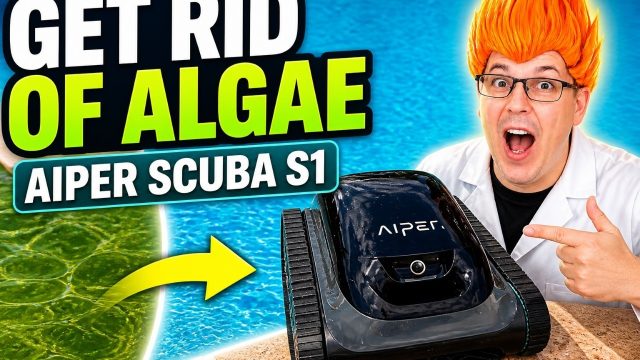
Robotic Pool Cleaner for Walls: Is Scuba S1 Worth It?
The Aiper Scuba S1 climbed the deep-end walls of my in-ground pool without a cable. Here is who its wall-cleaning setup makes sense for.
Affiliate disclosure: As an Amazon Associate I earn from qualifying purchases. This article may contain affiliate links, which means I may earn a commission at no extra cost to you.
If you are shopping for a robotic pool cleaner for walls, the important question is not whether it can vacuum a pool floor. It is whether it can actually climb, stay on the wall, and make useful passes without adding another hassle to pool care. I used the cordless Aiper Scuba S1 on the walls of my in-ground pool, including the deep end. I watched it travel upward while pulling in water, back down, reposition, and repeat—all without a cable in the pool.
That firsthand wall behavior is the reason to consider this particular robot. The Scuba S1 has several manufacturer-listed features, including app support, a claimed 180-minute runtime, and fine-filtration options. Those details may matter to the right buyer. But the practical starting point is simpler: I saw this unit work on the deep-end wall of an in-ground pool rather than treating walls as an occasional bonus.
A strong fit for in-ground pool owners who want a cordless robot that visibly climbs walls and offers dedicated wall, floor, and combined cleaning modes.
As an Amazon Associate I earn from qualifying purchases.
Why the Scuba S1 stands out as a robotic pool cleaner for walls
Many pool owners can deal with debris on the floor until the next cleaning cycle. Wall buildup is different. It can make a pool look neglected even when the bottom is relatively clear, and manually brushing those surfaces adds another task to a routine that already includes balancing water and emptying baskets. A wall-capable robot needs to make the transition from floor to wall, keep enough traction to travel at depth, and cover more than one short strip before returning to the bottom.
That is what made the Scuba S1 interesting in my pool. It climbed the deep-end wall while drawing in water. I could see it move upward, back away, turn, and begin another pass. Aiper calls that movement WavePath 2.0. On the wall, it appeared as an N-shaped pattern: the robot backed up, shifted its position, turned, and climbed again. The point is not the name; it is that the movement looked deliberate rather than random.
The cordless design is equally relevant to this use case. A corded robotic cleaner can still be effective, but its cable remains part of the job. It crosses the deck, sits in the water, and can require attention while the machine runs. The Scuba S1 cleaned my wall with no wires involved. For an owner who wants a robot primarily to take wall brushing off the weekly list, removing cable management is a meaningful convenience rather than a cosmetic feature.
I would keep the claim in perspective. I observed wall cleaning and the movement pattern in my own in-ground pool; I did not measure full-pool coverage, runtime, debris capture, or charge time. Pool geometry, wall finish, debris load, and water conditions can all affect what a robot does in another pool. Still, the central feature a wall-cleaner shopper needs to see—actual climbing and cleaning in the deep end—was present here.
| Best for | In-ground pools needing wall and floor cleaning |
|---|---|
| Power setup | Cordless battery-powered robot |
| Wall performance | Climbed my deep-end pool wall |
| Cleaning modes | Combined, floor-only, wall-only, Eco |
| Claimed runtime | Up to 180 minutes |
| Warranty | 2 years, according to Aiper |
What I saw on my in-ground pool walls
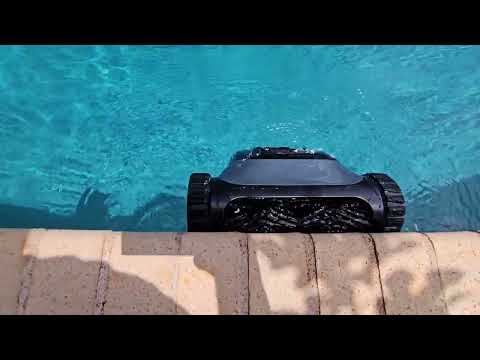
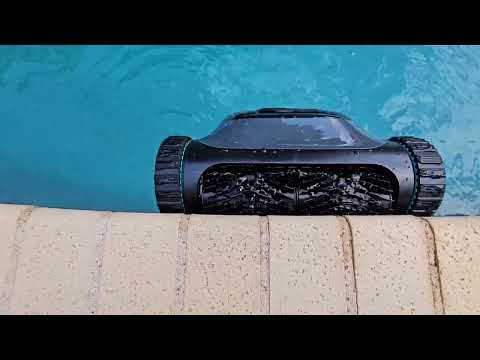
I ran the Scuba S1 in its combined cleaning mode. As I described it, that mode allocates the first half of a three-hour run to the walls and the second half to the floors. During the wall portion, I watched the cleaner go up and down the pool wall while pulling in water. It did this in the deep end, where the wall-cleaning ability matters more than a quick climb in shallow water.
Its route was easy to follow. The robot climbed, backed down, shifted, turned, and went again. That repeatable N-style behavior is what I identified as Aiper’s WavePath 2.0 pattern. I do not need a pool cleaner to make every pass in exactly the same line, but I do want it to look like it has a path instead of simply bouncing around. The Scuba S1’s wall motion gave me that impression.
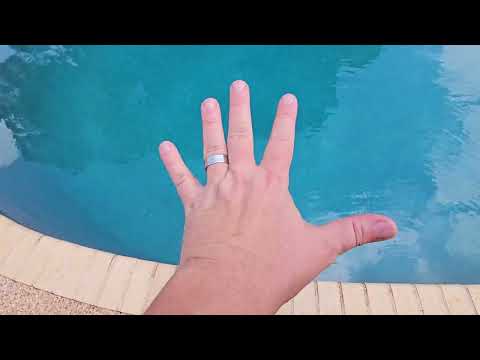
The test also had an unusual pool condition. We had received about seven inches of rain a few days earlier, and my pool was overfilled. The water level was near the edge. The robot is intended to rise out of the water briefly at the waterline, but it could not emerge as intended with the water that high. There simply was not enough normal edge exposure for that behavior.
That water-level situation did not stop me from seeing the unit climb and travel on the wall. It does, however, give buyers a useful expectation: waterline behavior depends on having the pool at a normal operating level. If heavy rain has filled the pool to the edge, restore the normal level before judging how the robot behaves at the waterline. A pool robot cannot compensate for an overfilled pool’s changed geometry.
It is also worth separating what I saw from what I did not test. I did not assess how much fine debris the filter captured in this session, and I did not time a complete cycle. My firsthand conclusion is therefore focused: the Scuba S1 climbed and cleaned the shown deep-end wall without a cord, and its wall route looked purposeful.
Cleaning modes give the Scuba S1 a clearer job
Mode selection is useful when it changes how you maintain the pool, not when it merely adds labels to an app or control panel. The Scuba S1 was described with four cleaning choices: combined wall-and-floor, floor-only, wall-only, and Eco. That lineup gives an in-ground pool owner a way to match the run to the problem instead of automatically using the same cycle every time.
- Combined wall-and-floor mode: This is the mode I used. It was described as spending the first half of a three-hour run on walls and the second half on floors. It is the sensible default when both surfaces need routine attention.
- Floor-only mode: This dedicates the run to the pool floor. It makes sense when settled debris is the main issue and the walls are already in good shape.
- Wall-only mode: This keeps the focus on wall cleaning for the full three-hour session described. It is the most relevant option for someone whose main reason to buy is reducing manual wall brushing.
- Eco mode: I described this as a vacation-style maintenance setting. It cleans for 50 minutes every 48 hours across a five-day period, with a day off. That is a light-maintenance approach, not the setting I would choose after a heavy debris event.
The value of those modes is choice. If the floor has collected debris, a floor-focused cycle is more direct. If the wall line needs attention, a wall-focused cycle avoids spending the run on an already-clean floor. For ordinary upkeep, the combined approach covers both jobs. Eco mode is the more hands-off option for periods when the pool needs maintenance rather than a full cleaning session.
I only observed the wall-cleaning portion during this pool session, so I would not treat the mode list as a substitute for matching the robot to your own pool and maintenance routine. But the modes themselves make practical sense for the owner who wants a cordless cleaner that can be used selectively, not just dropped in on one all-purpose schedule.
Where the cordless design helps most
“Cordless” can sound like a broad convenience claim, but it is particularly useful for wall cleaning. A robot that travels up and down a vertical surface has enough going on without a cable trailing behind it. In my pool, the Scuba S1 operated on the deep-end wall with no wires involved. That kept the cleaning setup straightforward and avoided a power cable running through the water.
For the right pool owner, that means less equipment to manage before and after a cycle. I could focus on whether the unit was climbing and repositioning correctly, rather than on where a cable was sitting. This does not mean a cordless robot is automatically right for every buyer. Battery runtime, charging routine, and coverage still matter. Aiper claims up to 180 minutes of battery life, but I did not independently time a full run or charging cycle.
What I can say is that the cordless format supported the Scuba S1’s core purpose in this session. It climbed and moved on the wall without the extra complication of a cable. If you have specifically been looking for a robotic pool cleaner for walls because you are tired of brushing and tired of managing a corded cleaner, that combination is the strongest reason to put this model on the shortlist.
Filters, app features, and specifications need a little context
Aiper lists a 3.5-liter filter basket, a claimed 4,200 GPH flow rate, and coverage for pools up to 1,600 square feet. Those figures are useful for comparing models, especially if you have a larger in-ground pool. They should not be read as a guarantee that every shape, surface, or debris condition will produce the same result. The layout of the pool and the material in it can be just as important as the square-footage number.
For filtration, Aiper lists a standard 180-micron fine-filter basket and a 3-micron MicroMesh ultra-fine filter. The 3-micron option is worth attention for buyers concerned with very fine debris. However, Aiper support material describes that ultra-fine filter as an optional upgrade in some contexts. Confirm the included filter configuration on the exact retail listing before ordering if ultra-fine filtration is an important part of your decision.
Aiper also claims app monitoring and control plus over-the-air firmware updates. I did not use the app during this pool session, so I would not buy the Scuba S1 on the assumption that the app will transform the cleaning experience. Treat those functions as possible convenience features. The demonstrated reason to consider the robot remains its cordless wall climbing and dedicated cleaning modes.
The same distinction applies to runtime. Aiper’s stated maximum is up to 180 minutes. That corresponds with the three-hour combined-cycle structure I discussed, but I did not independently verify maximum runtime, charge time, or complete coverage. Buyers who need a cleaner to finish a specific pool in one uninterrupted run should weigh their pool’s dimensions and conditions alongside the manufacturer’s stated limit.
+ Pros
- Cordless operation eliminates a pool cable
- Climbed and cleaned the deep-end wall of my in-ground pool
- Purposeful N-style wall movement with WavePath 2.0 behavior
- Selectable combined, floor-only, wall-only, and Eco modes
! What to know
- An overfilled pool can prevent the intended waterline rise behavior; restore the water to a normal operating level.
- Confirm the included filter configuration if the 3-micron MicroMesh filter is important to you.
- Aiper's app control and OTA update features are manufacturer claims; I did not use the app during this pool session.
Specs
| Spec | Detail |
|---|---|
| Product | Aiper Scuba S1 Robotic Pool Cleaner (2025 Upgrade) |
| Pool type | In-ground pool use; wall and floor cleaning |
| Navigation | WavePath Navigation 2.0, according to Aiper |
| Claimed runtime | Up to 180 minutes |
| Claimed coverage | Up to 1,600 sq. ft. |
| Claimed flow rate | 4,200 GPH |
| Filter basket | 3.5 L; Aiper also lists 180 μm filtration |
| Ultra-fine filtration | 3 μm MicroMesh filter listed by Aiper; confirm included configuration |
| App features | App monitoring/control and OTA updates claimed by Aiper |
| Warranty | 2-year warranty claimed by Aiper |
Who should buy the Aiper Scuba S1?
The Scuba S1 makes the most sense for an in-ground pool owner who wants one cordless robot that can address both walls and floors, with walls being a real priority. I saw it climb and clean the deep-end wall, and I saw it reposition in a deliberate pattern. Those observations matter more than a long list of untested extras if your current pain point is manual wall work.
It is also a good fit for the owner who values mode choice. Combined mode offers a regular wall-and-floor routine. Floor-only mode gives settled debris the full run. Wall-only mode is the direct response to a wall-cleaning problem. Eco mode is aimed at periodic light maintenance. You are not locked into using the same all-purpose cycle for every situation.
I would be more cautious if your purchase depends on a verified app experience, measured maximum runtime, or the certainty that a 3-micron filter is included. I did not test the app, charge time, full-pool coverage, or fine-debris collection in this session, and the included ultra-fine filter should be confirmed for the retail configuration. Those are questions to settle before treating those features as deciding factors.
For buyers comparing wall-capable robots, though, the case is clear. The Scuba S1 did the job I most needed to observe: it cleaned the deep end’s wall while cordless, moved through a recognizable wall pattern, and gave me separate wall, floor, combined, and Eco-mode options.
Waterline behavior in an overfilled pool
My waterline experience deserves its own note because it is easy to misread. The Scuba S1 was intended to rise out of the water briefly at the waterline. My pool had been hit by roughly seven inches of rain, leaving the water level right near the edge. Under those circumstances, it could not rise out of the water as intended.
This was not a wall-climbing issue. I still watched it travel up and down the wall in the deep end. It was a water-level issue: when the water is unusually high, the normal space at the edge is no longer available. If you are evaluating waterline behavior after a rainstorm, first return the pool to its normal operating level. That is the fair condition for expecting normal waterline behavior.
This is also why I would not use an overfilled-pool session to make a broader claim about every waterline condition. The useful takeaway is simply that normal water level matters. The robot’s wall climbing was visible despite the high water, but its intended brief rise at the edge was prevented by the pool being overfilled.
Scorecard
Climbed and worked my deep-end wall.
No cable in the pool to manage.
Dedicated wall, floor, combined, and Eco options.
Purposeful N-style repositioning on the wall.
App and exact included filter setup should be confirmed.
FAQ
Does the Aiper Scuba S1 really climb pool walls?
Yes. I watched it climb and clean the walls of my in-ground pool, including the deep end. It traveled up and down while drawing in water, then backed away, turned, and repositioned for another pass.
Is the Aiper Scuba S1 cordless?
Yes. It operated in my pool without a cable, so there was no power cord to manage while it cleaned the wall.
Can I run the Scuba S1 on walls only?
Yes. The Scuba S1 was described with a wall-only mode that dedicates the three-hour run to wall cleaning. It also has combined wall-and-floor, floor-only, and Eco modes.
How long does the Aiper Scuba S1 run?
Aiper claims up to 180 minutes of battery life. In the combined mode I used, the three-hour session was described as allocating the first half to walls and the second half to floors. I did not independently time a complete run.
Does it include an ultra-fine filter?
Aiper lists a 180-micron basket and a 3-micron MicroMesh filter. Because Aiper support material describes the MicroMesh filter as optional in some contexts, confirm the included configuration for the exact listing before you buy.
Will it rise out at the waterline if the pool is overfilled?
My pool was overfilled after heavy rain, with water near the edge, and that prevented the intended brief rise out of the water. Keep the pool at a normal operating level for expected waterline behavior.
Final recommendation
The Aiper Scuba S1 earns consideration if wall cleaning is the real priority in your pool routine. I watched it climb the deep-end wall, draw in water as it traveled, back down, shift over, and repeat. Its cordless operation kept a cable out of the pool, while its wall-only, floor-only, combined, and Eco modes provide useful ways to match the run to the maintenance job.
Buy it for the demonstrated wall-cleaning behavior, not for features you have not personally verified. Confirm the included filter setup if ultra-fine filtration is essential, and bring an overfilled pool back to its normal water level before expecting ordinary waterline behavior. For an in-ground pool owner who wants a cordless robot that visibly works on walls as well as floors, the Scuba S1 is a sensible option.
As an Amazon Associate I earn from qualifying purchases.