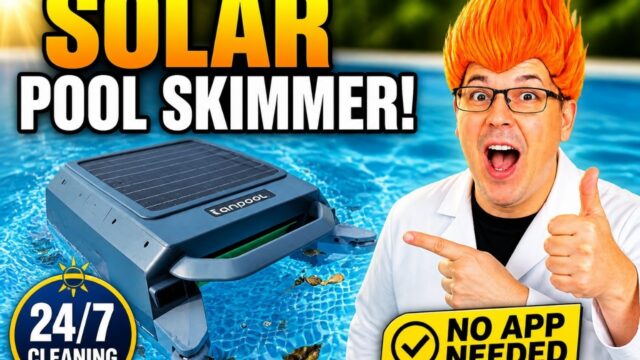
Solar Pool Skimmer: A Quiet Way to Catch Debris?
The Anpool P1 solar-powered pool skimmer moved on its own, turned off pool walls, and ran remarkably quietly in my above-ground pool demo.
Affiliate disclosure: As an Amazon Associate I earn from qualifying purchases. This article may contain affiliate links, which means I may earn a commission at no extra cost to you.
A solar pool skimmer makes sense when the mess is floating on top of the water: leaves, dead bugs, and the small bits that arrive while the main circulation system is off. The Anpool P1 did the basic job I wanted to see in my above-ground pool run. It moved around on its own, turned itself away from the pool wall, and was exceptionally quiet.
That last point matters more than people think. Pool equipment can turn a peaceful backyard into a mechanical soundtrack, especially when the pool sits near a patio, open window, or neighbor. I could barely hear this skimmer on the water. Compared with similar units I have used, the P1 stood out as very, very quiet.
The useful way to view this product is not as a replacement for the pool system. It is a roaming helper for the surface. If the recurring annoyance is waking up to insects and leaves before they have a chance to sink or become waterlogged, a solar pool skimmer aims at that particular problem without making manual netting the only answer.
The Anpool P1 is a promising supplemental solar pool skimmer for quietly collecting floating leaves and bugs without running the pool pump just for surface debris. I liked its quiet operation and simple self-driving behavior, but I would treat 24/7 operation as an advertised goal rather than a result I established in my short run.
As an Amazon Associate I earn from qualifying purchases.
| Type | Solar-powered robotic surface skimmer |
|---|---|
| Pool compatibility | Above-ground and in-ground pools |
| Debris target | Floating leaves, bugs, and similar debris |
| Navigation | Autonomous movement with wall-turning behavior |
| Charging | Top solar panel and rear DC charging connection |
| Debris collection | Removable basket |
Why use a solar pool skimmer instead of running the pump?
Do not confuse the Anpool P1 with a replacement for a pool’s filtration system. It is not that. It does not take over circulation, sanitation, brushing, vacuuming, or water balancing. Its role is narrower: traveling across the top of the water and catching floating material in its path before that material turns into another cleanup task.
That can be a useful division of labor. A pool pump and filter address the overall water-maintenance job. This kind of skimmer focuses on the visible surface layer. When leaves or bugs are drifting around, it is easy to understand why someone would want a dedicated device for that job rather than reaching for a net every time something lands in the pool.
I especially see the appeal during periods when the pool is not getting much use. Leaves and insects do not stop arriving simply because swimming has slowed down. In that situation, running the circulation pump overnight solely because of a few floating items may feel excessive for the specific task. I described the P1 as a potentially more electricity-efficient option for surface debris than running my pump all night, since the skimmer uses its own solar-based approach rather than relying on the pump for that surface-only work.
That does not mean the pump becomes optional. It means the P1 may be a convenient supplemental layer between normal maintenance sessions. The right expectation is a cleaner-looking surface and less floating debris to deal with by hand—not a fully automated replacement for every part of pool care.
My hands-on experience with the Anpool P1
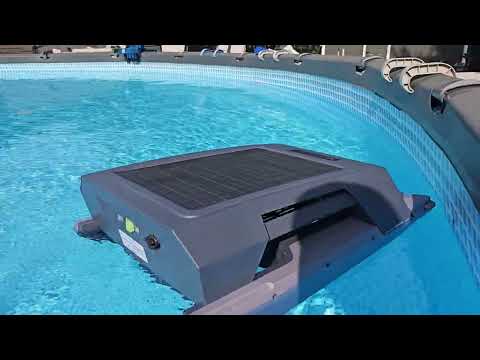
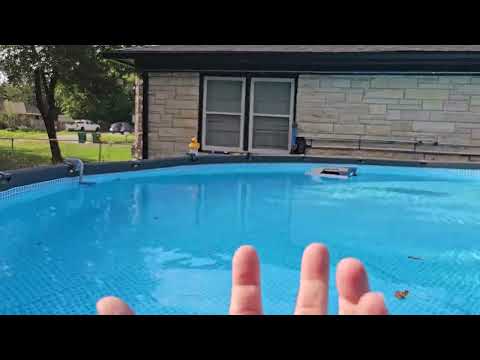
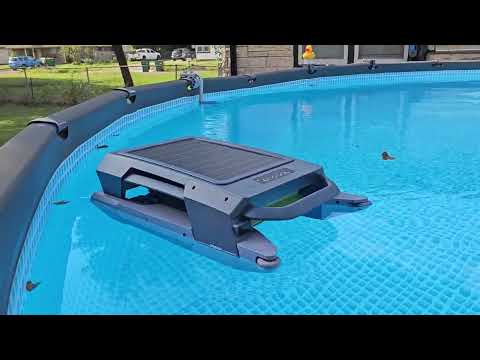
I put the Anpool P1 on the surface and let it go. It moved around the pool independently rather than needing me to steer it. In the short on-water run, it traveled across the surface and collected floating debris in its path. Leaves and dead bugs are the examples I had in mind, because those are exactly the kinds of things that tend to accumulate on the water.
The device has a solar panel on top, a charging connection at the rear, and a removable basket for what it collects. Those are straightforward features, but they are the practical parts of ownership. The solar panel is central to the product’s purpose. The rear connection gives it another charging option. And the removable basket means the debris has a designated place to go instead of requiring a complicated cleanup routine.
I liked the basic simplicity of the design. A surface skimmer should not create a large amount of extra pool work. When the basket needs attention, the idea is simple: remove it, empty the collected material, and return it to the unit. I did not measure basket capacity or establish an emptying schedule, so I would not assume one routine fits every pool. A pool receiving a steady leaf fall will naturally need more attention than one with only an occasional bug or leaf.
The immediate surprise was the sound level. I paused speaking so I could listen, and I could barely hear the P1 running. I have used other similar skimmers, and this one was noticeably quieter. For an owner who wants a device circulating on the surface while people are outside, that can be more meaningful than an impressive feature list. Quiet operation makes the automated aspect easier to live with.
I also appreciated that its behavior was easy to understand. It was not trying to act like a robotic floor cleaner that maps every part of a pool. It floated, moved, encountered the wall, turned, and continued. For this category, that uncomplicated routine is the point. A surface robot that repeatedly needs rescuing would simply trade one chore for another.
Wall avoidance worked in my pool
The P1 did not map my pool like a high-end robotic floor cleaner, and I would not expect it to. A floating surface skimmer has a different job. What matters is whether it can handle a wall or obstacle well enough to keep working rather than sitting in one place. In my run, I watched it encounter the pool wall, turn itself around, and continue moving.
That behavior is important because a roaming pattern only helps when it remains a roaming pattern. The unit turned at the wall instead of simply pressing into the side. I saw that happen more than once during the short demonstration, and it was a reassuringly practical result. It gave me confidence that I could let it travel without standing over it every few minutes in this pool.
Anpool advertises anti-stuck navigation. What I observed was consistent with that general goal in a simple above-ground-pool run, but I would keep the claim in perspective. I did not test a long list of obstacle situations, and I cannot say how it handles every pool configuration. Steps, ladders, drains, cover hardware, wind, and irregular shapes can alter how any floating cleaner moves.
That is why I would watch a new skimmer during its first few uses in your own pool. The P1’s wall turn was a real positive in my setup, but every pool has its own odd areas. A first-run check lets you see whether it has an open surface route and whether there are places where you will want to intervene or remove it.
Quiet operation is the P1’s strongest selling point
Plenty of pool products promise convenience, but convenience is reduced if the product is irritating to hear. The P1’s quietness was the clearest differentiator from my short experience. I could barely hear it operating. That is not a claim about laboratory sound levels; it is my immediate real-world impression while it floated and moved around the pool.
For some shoppers, that point may be more useful than the solar panel itself. A pool near a seating area can make every motor sound noticeable. If you prefer to spend time outside without another obvious machine running, a very quiet surface skimmer has an advantage. It can continue its task in the background instead of demanding attention through noise.
This is also why I would not overcomplicate the buying decision. If you need wall scrubbing, settled-debris pickup, or full filtration, you are shopping for a different tool or a broader pool-maintenance solution. If the job is catching leaves and bugs floating on top, the P1’s quiet autonomous movement is directly relevant.
How the solar charging setup fits pool maintenance
The top-mounted solar panel is the obvious selling point. The concept is to leave the skimmer in sunlight so it can recharge during the day while it works around the surface. I also pointed out the charging connection on the back of the unit. Anpool advertises DC charging in addition to solar charging, which gives owners another stated charging option when sunlight is limited.
This combination makes sense in principle for a surface cleaner that is intended to spend time outdoors. Sunlight is available where the device works, and a rear charging connection offers flexibility beyond solar exposure. Still, charging details are exactly where realistic expectations matter. Weather, shade, season, and the amount of debris a pool receives can all affect how a product fits into an actual routine.
Anpool represents the P1 as capable of 24/7 operation. I did not run it overnight, through cloudy conditions, or across multiple days, so I cannot confirm continuous runtime. I also did not establish how long the battery lasts between charges, how quickly solar charging replenishes it in varying conditions, or how the charging system performs over the long term.
My practical takeaway is more modest and more useful: the solar panel and charging connection support the idea of a self-contained surface-debris helper. If your aim is to reduce how often you run the pump just to address visible leaves and bugs, that approach may be appealing. Just do not buy it on the assumption that a short run establishes every advertised all-day or all-night result.
What the removable basket means in day-to-day use
The P1 uses a removable basket to hold collected debris. That is a simple design choice, but it is the part that makes the skimmer’s work usable. A device can move around nicely, but the collected leaves and insects still need a place to be contained and emptied.
I would treat basket checks as part of normal pool upkeep. When debris is light, the basket may not need much attention. When leaves are falling heavily, it will be doing more work and should be checked more often. I did not test its capacity or fill it under a controlled debris load, so I cannot give a precise interval. The sensible approach is to look at it regularly until you learn your pool’s pattern.
Keeping the basket clear also supports the basic purpose of a surface skimmer: allowing it to continue gathering material as it travels. It is not a drawback unique to this model; it is part of owning a product designed to collect debris. The benefit is that the basket is removable, so the cleanup path is direct rather than complicated.
+ Pros
- Exceptionally quiet operation compared with similar skimmers I have used
- Moved autonomously around the pool surface
- Turned away from the pool wall in my on-water run
- Removable basket makes debris emptying straightforward
- Top solar panel can recharge the unit in sunlight
! What to know
- This is a supplemental surface-debris cleaner, not a replacement for filtration or vacuuming.
- Anpool advertises 24/7 runtime, but I did not test overnight or multi-day operation.
- Check the basket regularly when leaf load is heavy.
- The unit is described as suitable for both above-ground and in-ground pools.
Who should consider the Anpool P1?
I would consider this skimmer if you have a recurring surface-debris problem and want a quieter, more automatic option than regular manual netting. It makes the most sense for owners who often find leaves, insects, or similar floating debris in the morning and want a device dedicated to that surface layer.
- Above-ground pool owners: I used it in an above-ground pool, where it had room to travel across the surface, turn at the wall, and keep moving.
- In-ground pool owners: The P1 is described as suitable for in-ground pools as well. I would still assess the particular layout and obstacles before treating any floating cleaner as hands-off.
- Noise-conscious owners: This is the strongest reason to consider it based on my run. It was unusually quiet compared with similar skimmers I have used.
- Owners seeking a supplement: It can help with floating debris, but it does not replace filtration, circulation, vacuuming, brushing, or water chemistry maintenance.
I would not buy any surface skimmer robot expecting it to solve every pool-cleaning task. It will not scrub walls, vacuum material that has settled below the surface, or correct cloudy water. That is not a criticism of the P1; it is simply the division of labor. This product works on top, while the rest of the maintenance system handles the broader pool.
Buyer checks before making a solar pool skimmer part of the routine
Start with a normal open-water run and watch how the skimmer handles your pool. The P1 turned well at a wall in my short run, which is encouraging, but your pool may have different factors. A ladder, steps, a drain, cover equipment, strong wind, or a nonstandard shape may affect its route. The goal is not to assume trouble; it is to learn how the device behaves in the space where you will actually use it.
Think through the type of debris you are trying to manage as well. The P1 is for floating leaves, dead bugs, and similar material. That is a distinct job from cleaning dirt or debris already resting on the bottom. If surface debris is the frustrating part of your routine, the product is well aligned with the problem. If the real issue is settled debris, poor circulation, or water balance, address those needs with the appropriate pool equipment and maintenance steps.
Finally, keep a realistic view of solar power. The top panel is a meaningful feature, and the rear charging connection provides another advertised option, but I did not conduct a long-term charging test. Do not treat my quiet, successful short run as a guarantee of multi-day runtime in every season or weather pattern. It is better to see the P1 as an automated helper whose long-term charging behavior should be evaluated in your own sunlight conditions.
Specs
| Spec | Detail |
|---|---|
| Product | Anpool P1 Solar Powered Pool Skimmer |
| Primary power feature | Top-mounted solar panel |
| Additional charging | Rear charging connection; DC charging advertised |
| Cleaning area | Water surface |
| Debris container | Removable basket |
| Pool types | Above-ground and in-ground |
| Advertised navigation | Anti-stuck navigation |
| Advertised modes | Dual cleaning modes |
| Advertised runtime | Up to 24/7 operation claim |
How I scored this solar pool skimmer
I scored the P1 highly for the things I directly observed: quiet operation, independent movement, and turning at the pool wall. Those are the core behaviors that make a surface skimmer feel convenient rather than fussy. The removable basket also earns credit because it keeps debris disposal straightforward.
I was more reserved on long-term runtime certainty. That is not because the short on-water run was poor; it was because the run was short. Solar charging, DC charging, anti-stuck navigation, dual cleaning modes, and 24/7 capability are advertised features or claims, but not all of those claims were established over extended use in my pool. A useful review should distinguish the immediate experience from the unanswered long-term questions.
Scorecard
I could barely hear it running.
Moved independently and continued its route.
Turned itself around at the pool wall.
Removable basket keeps emptying simple.
Solar and DC charging are offered, but I did not test multi-day use.
Frequently asked questions
Does the Anpool P1 work in above-ground pools?
Yes. I ran it in an above-ground pool, where it moved across the surface and turned away after reaching the pool wall. It is also described as suitable for in-ground pools, although I would still watch how it handles a specific pool’s layout and obstacles.
Is the Anpool P1 loud?
No—not in my experience. I could barely hear it while it was operating, and I found it noticeably quieter than other similar pool skimmers I have used. Quiet operation was the clearest standout from my short run.
What does this solar pool skimmer collect?
It is intended for floating debris. In practical terms, that includes leaves, dead bugs, and similar material on the water surface. The unit has a removable basket for the debris it gathers.
Does it avoid pool walls?
It did during my run. I watched the P1 encounter the wall, turn itself around, and continue moving. I did not test every type of obstacle or pool shape, so it remains sensible to monitor any new surface skimmer in your own pool at first.
Can it replace a pool pump or filter?
No. This is a supplemental surface cleaner, not a replacement for a pool’s circulation and filtration system. It does not replace vacuuming, brushing, or water chemistry maintenance either.
Will it really run 24/7?
Anpool advertises 24/7 runtime, and the unit has a top solar panel plus a rear charging connection. I only used it in a short on-water run, so I cannot confirm overnight, multi-day, cloudy-weather, or long-term continuous runtime.
How often should the basket be emptied?
That will depend on what lands in your pool. I did not measure basket capacity or test a heavy debris load. Check it regularly at first, particularly during periods of frequent leaves, so you can establish a routine that matches your pool.
Final recommendation
The Anpool P1 Solar Powered Pool Skimmer gets the fundamentals right in the areas I care about most for this category: it moves on its own, turns away from walls, picks up floating surface debris, and does so without much noise. That makes it a sensible option for keeping leaves and bugs from lingering on the water between normal pool-maintenance sessions.
If you want a quiet helper for floating debris—not a substitute for your pump, filter, or vacuum—the P1 is worth considering. Its short-run behavior was promising, especially the wall turns and very quiet operation. Just set realistic expectations around sunlight, basket checks, and long-term runtime, because I did not test those over days or nights.
As an Amazon Associate I earn from qualifying purchases.